Wednesday, February 8, 2012

It is a hard thing to write well.

It is with very great pleasure that I introduce a magnificent young authoress, Abigail Hartman, who has published her novel (The Soldier's Cross) with Ambassador Emerald International. I have found her to be a wealth of knowledge and a tried and true scribbler. She graciously agreed to be interviewed on the whole subject of Writing Romance, and I hope you will be as aided and delighted by her answers as I was. :)


1. In a recent post on Scribbles and Ink Stains, you told us your views on romance in fiction--can you encapsulate your thoughts on the subject here?

It is my opinion that romance can be a very difficult thing to write well, but that much of the trouble comes from authors trying to follow the usual trodden path—the meeting, the sparks, the obstacles, the resolution.  This is the tried-and-true method; it’s how we’re told to write romance.  But it isn’t the only way to do so.  As writers, we have to consider two major things: how the romance forms a part of the plot as a whole, and what sort of characters the hero and heroine are. The first determines how much emphasis you will end up placing on the relationship, while the second dictates what that relationship is going to look like.

2. Do you go by the rule that all fiction should have some level of romance? If so, elaborate.

I don’t believe that all fiction must have romance.  As you pointed out in a comment on the abovementioned Scribbles and Ink Stains post, stories must have relationships, but they don’t always have to be romantic in nature.  Novels for younger readers frequently have little, but not always zero (The Gammage Cup, for instance, has a little bit woven into the plot).  I think that any romance must be organic to the story, not shoved in where it doesn’t belong or ripped out when it ought to be there.

3. What is romance done well?

I cannot find this quote in the book, but in the 1996 “Pride and Prejudice,” Jane Bennet says, “A marriage where either partner cannot love or respect the other…that cannot be agreeable to either party.”  Good romance doesn’t depend on passion and pizzazz; it depends on the love and respect that exist between the characters.  Everything else is but the icing on the cake—it makes for better eating, but it shouldn’t be treated as the substance.

4. What is romance done poorly?

I find the worst sort of romance to be the crass kind, but I’m assuming that is a given.  I think of poorly done romance as the kind where no foundation is laid for the attachment, nothing given to show that the “love” portrayed is deep and abiding.  In essence, where you are presented with the trimmings but not the actual turkey.

5. In your opinion, who is qualified to write romance?

Anyone who is going to write romance must have at least some understanding, beyond just the basics, of what Love is.  So much of modern writing (and even some older literature) presents love as nothing but insipid emotions, something that weakens the character rather than strengthening him.  God is Love, and God is by no means weak.  Really, Shakespeare wasn’t far wrong in one line of his famous sonnet: “O no! it is an ever-fixed mark that looks on tempests and is never shaken…”  Love is powerful and self-sacrificing, a force to be reckoned with.  Writers must begin to see that, I think, before they can write about it.

6. The three most important elements to well-written romance? 

I am not sure I could give a definitive answer as to the most important elements, but I’ll combine the hero and the heroine and say “characters,” and on the heels of that, “chemistry.”  The characters must come together in an interesting manner, no matter how small a part the romance plays in the story.  And then, last of all, I’d also say that you have to have a story-line to support the romance. 

7. I've heard it said that it is literary suicide to stick romance in an adventure novel. Do you agree? Why or why not?

I have never heard that, but I heartily disagree!  This person has obviously never read The Last of the Mohicans.  I never read a more adventurous adventure novel, but it had romance in it as well.  I think well-written romance can always be used to the author’s advantage, no matter what genre. 

8. A love-interest in a story can either advance the plot, or prove a foil for the protagonist--how have you portrayed this sort of character in your novels?

My first thought was that this question was going to be difficult, but then it occurred to me that these two appear distinctly in two of my novels, respectively: Wordcrafter and The White Sail’s Shaking.  In Wordcrafter, Justin’s love interest is Jamie Fairbairn.  She is his opposite in everything: easy where he is uncomfortable, outgoing where he is shy, changeful where he is steadfast and loyal.  Her character serves as the backdrop for Justin’s weaknesses and strengths; thus, she is his foil.

In The White Sail’s Shaking, the situation between Tip Brighton and Marta Rais is different.  Their romance serves to advance the plot, giving Tip one more thing to fight for and Marta one more thing to be afraid of losing.   

9. Popular romance-novels: a worthwhile endeavor, or a waste of ink and creativity?

There’s creativity involved? 

I jest—mostly.  In general I must say I find them a waste of ink, paper, and time, both for the writer and the reader.  Romance is one of those things best incorporated into a story, rather than made a story in its own right.  There are exceptions, although even with classic examples, they generally have a secondary purpose; in general, however, I think this is a good rule to live by. 

10. Do you think a novel without romance is possible? If so, what elements are heightened in place of it?

I think it quite possible, and many of Rosemary Sutcliff’s novels are good examples of it.  Earlier I mentioned that all novels have relationships; if you don’t have the romantic sort, which tends to be dominant, others can shine more brightly: friendships, for example, or familial love.  In the modern onslaught of romance novels, these tend to be neglected and their importance forgotten. 


11. In your opinion, are Jane Austen's books classified as romance or social commentaries?
 
Mostly romance, I should say.  Although she does obviously enjoy poking fun at society, she doesn’t delve into its evils the way a Dickens or a Gaskell did.

12. Which would you rather find in a novel? A love-interest, or no romance at all?

I like a bit of romance in most of the stories I read, but I can enjoy books of either stripe.  I think it’s really all in the execution.  (But not of the characters, please!)

Tuesday, February 7, 2012

"A Meager Mind" --Short story for the fellows.

Hello everyone! I am sure you all would be overjoyed and quite interested to hear (if you haven't already) that today is Charles Dicken's 200th birthday! I could not let such a monumental occasion go by without applauding it, so here's my clapping for the day:
*clapclapclapclapclap* :)
I wanted, again, to remind you to hurry and send your entries for my contest to: theinkpenauthoress@gmail.com. 
Please don't hesitate! Also, look out for a fabulous interview tomorrow! :)
Now for the real business of this post. It came to my attention [rather abruptly, in fact] that the "Heigh-Ho for a Husband" contest [apart from the name, you'll understand] is not only for women. Any fellow who reads this blog could enter the contest, and I'd give them a fair chance. I promise! :D And just to show my good humor and good intentions, I wrote you fellows [and any girls] a piece that I hope you enjoy. 
Hic est....


“A Meager Mind”
By Rachel Heffington

“Let it never be said that a meager mind induced me to marriage.” Charles Buxworthy ground the butt-end of his cigar into the lap of a china shepherdess on the mantelpiece and turned about, viewing his listener with a mocking smile.
His friend lazed back on the sofa and crossed his feet. “A meager mind, Charley-boy?”
Charles crossed his arms and paced from one end of the red hearth-tiles to the other. “Isn’t it a rule with gentlemen that the only ones who marry are the ones who haven’t enough wit about them to survive the scramble on their own?”
“Is it?”
“What else?”
“Come now, Charley—you can’t tell me you’ve never heard tell of the blessed state of matrimony?”
Charles scoffed. “Really, ‘Dolphus. If you are going to soften into a sap all at once I’ll turn you out on your botto this very moment.”
“And that would be a shame, for I am not sure Emma would like to see me banged up in such a fashion the day before the wedding.” Adolphus grinned at his bacheolor-companion and smoothed the blue wool of his coat-sleeve. “Rather an improvement, don’t you think? Emma’s done me up nicely ever since she found out that you do the tailoring around here.”
Charles felt his blood rush to his face at this slight upon his appearance, and he fervently wished that the wild-haired fellow with the limp cravat who stared him out of countenance from the mantel mirror was not his own reflection. “There’s the devil to pay once you leave, ‘Dolphus.”
Adolphus threw back his head and laughed loud and long. “Why? Because I was the richer debtor to our landlady? Don’t worry old boy. I plan to pay the Aged Lady before I cart my baggage out.”
“And I’ll have to follow close behind—you haven’t any spare rooms in Wimpole Street, have you?” Charles rushed to his friend’s side and placed a muddy boot on the much-abused arm of the sofa.
Adolphus grimaced. “Not a single one that will bear your living in it—Emma’s having them all papered and furnished and painted and I know not what else.”
Charles, thoroughly disgusted with the state of his friend’s hitherto good sense, threw his arms out and scoffed. “And you will bear this meddling that interferes with aiding an old friend in need?”
Adolphus raised an eyebrow and fingered the gold ring on his left hand. “Need and want are two very different things, Charley-boy. You need a roof—you want cigars and expensive gloves, and port wine at every meal. Pay your debts before you turn your livelihood into pocket-change, I beg you, and you won’t find yourself boxed in.”
Charles bit his lip, too vexed with his companion to further the conversation. The dusty-faced clock on the mantel showed two hours till dinner-time, and until then—when he would have to recite a speech and play toast-master at the rehearsal dance—he had to bear the love-sick swain as best as he could. He stole a sidelong glance and frowned at the satisfied, exulted look on Adolphus Carriagehill’s face—the look that had stolen his friend’s attention from him long before Charles had ever had to endure lengthy discourses on the beauties, the charms, the talents, the witticisms of the fabled Emma Downey. He hated Emma Downey. Hated her for being beautiful and charming, talented and witty. He and Adolphus had bached it together ever since Law school and it wasn’t every day you found such a good-natured fellow to room with. They were more than friends—they had been brothers. And the idea of giving Adolphus over to a pretty, winsome angel with soft arms and forget-me-not eyes was odious. He’d rather be hanged.
“Have any more cigars, Charley-boy?” Adolphus’s lazy, quiet drawl sifted through the disgruntled silence of the room and pricked Charles’ temper. He hurled the paste-board box of cigar-ends at Adolphus as a pouting child might hurl a toy. Adolphus looked round and smiled patronizingly. “Tut tut, Charley, my good fellow—bachelordom making a cross-patch out of you?”
“Oh do be quiet.”
“No. No, you cannot refuse a bridegroom the right to talk—especially when you are acting as his best man.”
“Oh hang the best man.”
“Not till after the wedding, I’m afraid, my dear chap. Then you can choose the day and the hangman and I’ll tie your noose for you. But till then you’ll have to bear my prattling.”
Charles was outraged at Adolphus’ obvious amusement. What humor one could find in such a situation was beyond him. He wished he had a dozen cigar boxes to hurl at the back of that finely combed head. Adolphus looked round again, then grunted and shifted himself. “Gives one a devil of a crick in his neck to play peep-bo in that fashion. Now listen, Master Congeniality. Emma and I are convinced you are ailing.”
“There’s nothing more wrong with me than you,” Charles muttered.
“Are you intimating that I am ill, or I am the illness?”
“Both, if you continue talking along in this stupid manner.” If Adolphus didn’t shut his gob directly he’d burn his tuxedo and cummerbund immediately and refuse to attend the wedding. Women made a hash of everything good in this life.
“All jesting aside, Charley, Emma and I have decided between ourselves that we will get you married.”
Charles ground his teeth. “You just try.”
“Oh, we intend to, believe me. There’s a dear angel of a girl who is Emma’s intimate friend—her name is Arianna Sandistone and—”
Charles covered his eyes with his hand and cracked his spine against the sofa-back. “Oy what a name!”
Adolphus bit the end of a cigar and made a face. “What rotten tobacco you indulge in—anyhow, Arianna Sandistone is a perfect beauty—second only, I believe, to Emma (for no one could rival her in form and figure) and I intend to introduce you.”
“Well I decline the favor.”
“But you will have it nevertheless.” Adolphus swung himself up from the sofa and straightened his cravat in the mantle-piece mirror. “As it is, I remembered I have an errand to perform and so I will leave you to your agonies. See you tonight! Oh—and Charley?”
“What?” Charles growled.
“Do try to come clean? I’d hate to have my best man wearing a gravy-spattered cravat or inky fingers.”
*             *             *             *
Charles Buxworthy had seldom paid such attention to his appearance than he did that night. Not for any Arianna Sandistone in the whole of London, but because Adolphus was a good sort of fellow—the best, really, and he would never intentionally disgrace him. Strapped into his tuxedo, immaculate gloves stuffed onto his hands and hair combed and waved in to the dandiest degree, Charles stepped out of the hired chaise at the steps of the Lilliburt Club. Torches lined the marble steps leading up the ornate doors which were cracked just enough to emit a faint stream of music and laughter and the clink of champagne glasses.
Despite his dire feeling about the whole of the evening, Charles’ blood quickened at the familiar lure of a party. He was always his best when out in Society dancing, laughing, making witty banter with anyone who would listen—in addition, he could eat and drink at someone else’s expense and thus save the morrow’s ration of bread and meat. In the Season he seldom ate more than two or three meals at home, and—apart from the usual expenditure in new gloves—it was the cheapest of all times of the year.
The sounds of gaiety drove the last lingering rays of discomfort from Charles’ mind. There was all day tomorrow to rue Adolphus’ marriage—he intended to enjoy himself. The lackey at the door directed him to the ballroom off the corridor, and Charles paused on the threshold, enjoying the sights of an evening in full swing. Ladies, gorgeously appareled in silk and diaphanous gowns, long trains swept over their arms, danced with gentleman in immaculate suits. The orchestra at the end of the hall played a slow, wistful air and the couples waltzed in time to the music.
Her brow is like a snowdrift....her neck is like a swan…the familiar words coursed through Charles’ mind as he recalled his pretty Scotch nanny singing to him as a wee boy. …and her face it is the fairest that e’er the sun shone on…that e’er the sun shone one and dark blue is her e’e…Charles slipped through the whirling couples and took a long-stemmed glass from the waiter standing hard by…and for bonny Annie Laurie I’d lay me doon and dee…Charles drained his glass and eyed the couples, keeping watch for Adolphus and his dreaded bride. Ah. There they were by the potted palm. He crossed his arms and glared at them, taking in each piece of Emma’s attire with a practiced eye and discounting it in his mind. French silk? Ah. She was an expensive woman and would drain the Carriagehill Coffer to be sure. Brussels lace? Likewise. Ugh. And that feather, though very attractive, had cost a pretty penny if he was any judge.
Gradually, like soot drifting over the clean air, speckles of melancholy clouded Charles’ vision of the fun to be had at this sort of party. He growled to himself over the unfairness of it all and beat his foot to the tune of the song. The fiddle sang out the last notes of the song and the dancers broke apart, the charm of the scene disbanding as quickly. Charles continued to glare as Adolphus and Emma approached. The both of them were beaming like a pair of diddled geese, and Charles wished his friend could see how utterly stupid he looked.
“Charley-boy you do me credit.” Adolphus brushed a finger against Charles’ black suit.
Charles nodded stiffly and extended his fingertips to Emma who touched them and giggled.
“Charmed, I’m sure,” Charles said with obvious difficulty in meaning it.
Emma snuggled closer to Adolphus’ arm and giggled again. “I hope we shall be good friends eventually—Arianna and I will reform you.”
Charles puffed his chest out and shook his head till his stubborn curls came loose from their coaxed tameness. “Never madam.”
“Never to be friends? Well that is too bad.” Emma had that same hidden laughter in her eyes that he hated seeing on Adolphus’ face.
Charles felt himself flush hot. “I meant, madam, that you shall never reform me.”
Emma laughed. “Very well, you stubborn beast. We ought to lock you up in the Zoo and charge pennies for the children to see the Cross Old Bachelor.”
Charles nodded and grumbled within himself over “Cursed foolishness.” Emma and Adolphus sauntered off across the room, arm in arm, and the fiddler started another tune. This time the music inspired Charles with a devilish feeling of fun and derring-do. He would show Adolphus that he didn’t need any help having a good time on his own. Why did he need a brother and a friend to enjoy himself? He didn’t need one, that’s what. Charles scanned the room to see where he would begin.
It was a reel the fiddler played and he needed a vibrant partner—a girl who had some spark about her and could dance with life in her feet. He looked into every feminine face that passed but none caught his fancy. They were all too insipid, too calm, too befeathered and beruffled to suit his purpose. Charles looked longingly at the door to the cool, dim corridor, but he was startled to see a perfect Juno silhouetted, blue and white, against the dark doorway. She carried a little blue fan and her dark hair shone under the lamplight. But all these things fell to the wayside of Charles’ sight when she lifted her lashes and—from across the room and the dozens of whirling couples—she looked at him and laughed. That was the sort of girl he needed. Charles ducked past the dancers, wove through the waiters, and arrived at the young lady’s side breathless and panting, cheeks hot and cravat askew.
“Do you have a partner?” he asked.
The girl laughed again and her eyes were full of fun. “That isn’t the way to ask, you know. A girl doesn’t like admitting she’s unengaged.”
Charles bowed low. “My apologies madam. May I have the honor of this dance?”
“Are you a good dancer?” The girl fluttered her fan and laughed at him behind it.
What a saucy miss this was! Charles glowed inwardly. This would show Adolphus. “A tolerably good one,” he answered. “Especially for a reel.”
The young lady looped the blue of her skirt into her arm and put out her small white hand. “Than by all means, Monsieur, you may have the honor.”
Glowing with pride, filled with triumph at having secured the bonniest and brightest lass in the room, Charles led his conquest to the top of a line of dancers and bowed to her. By George she was the prettiest little woman he’d seen for many a day—and she was devilish charming too, the way she held her laughter in her eyes. And the way she danced! Charles laughed gleefully to himself over the way he would be able to flout Adolphus’ patronage when it came time to be introduced to that horrid Arianna Sandistone—he had already found the best girl in the room.
The music whirled on and Charles and his beauty wove in and out of the other dancers, finally coming together at the climax of the dance. She curtsied, her breath coming quick and happy between her rosy lips, and a wild, gypsying pink surmounting her cheek. Her black lashes swept her lids as she glanced upward and she laughed at Charles. He could hardly believe such a charming person was actually laughing at him. For him. It made him feel a king all at once.
He kissed her hand and smiled. “May I have the honor of knowing your name, my lady?” he asked, waiting to hear what he vowed would be the name he’d adore from this moment unto eternity.
The girl laughed again and curtsied low, then plucked a blue sprig of larkspur from her hair and offered it to him. “My name, good sir, is Arianna Sandistone.
The End

Monday, February 6, 2012

Heigh-Ho update!

Hello Everyone! This is a reminder that the "'Heigh-Ho' for a Husband" Blog party and Contest is still open and accepting entries until February 14th! (The Giveaway closes on Feb. 13) Please don't wait to send your entries--I don't want you to forget, and as I know that several people are working up simply splendid entries, I'd hate for anyone to miss out. 

Click Here for the Contest information!


Tally-ho! Have fun, everyone. :)

Friday, February 3, 2012

The Saint Valentine Post Presents.....


Hey everyone! As a favor and treat for all of us, Jenny [The Penslayer] consented to put together a nonsensical interview for me. I wrote up the questions, assigned her a personality, and she answered the questions. Enjoy it! It's rather a masterpiece. ;)

********

Breaking NewsThe St. Valentine Post interviews the Hon. Ms. Lavinia Lacklove, chairwoman of The Society of Aged Maidens, on the topic of matrimony:

1. What is your Society's anthem-song?
To God my earnest voice I raise,
To God my voice imploring prays;
Before his face my grief I show
And tell my trouble and my woe.

When gloom and sorrow compass me,
The path I take is known to Thee,
And all the toils that foes do lay
To snare Thy servant in his way.

                                                          O Lord, my Saviour, now to Thee,
                                                    Without a hope besides, I flee,
                                                       To Thee my shelter from the strife,
                                                         My portion in the land of life.

                                                         Be Thou my help when troubles throng,
                                                         For I am weak and foes are strong;
                                                         My captive soul from prison bring,
                                                        And thankful praises I will sing.

This is taken from Psalm 142 and is to be sung to the pretty if melancholy tune of Rockingham Old.  After some long debate among the Society [TM], we decided that the foes were not blackguards and n’er-do-well young men seeking to marry for money, but they could very well be and that the passage is open to such meaning; we also decided that the “prison” is not matrimony itself but, in this instance, could be construed as discontentment, idleness, gossip, frivolity and wanton husband-seeking.  We have approached the local canon with this exegesis and he maintains that David was not thinking of matrimony at all while he made this lyrical petition. 

2. If a woman were to remain single all her days, what would your sage wisdom and experience advise her to do?
Absolutely do not remain idle, and have as few friends as possible.  Idleness and many friends lead directly to gossiping, I dare swear, and I would as soon stick both my knitting needles in my ears as hear a woman go on about His Honour So-and-So of Blankishire who had an affair with the maid and Lady This-and-Such had had enough and—knitting needles! 

In general I dislike the term “single.”  It sounds like an order at the grocer’s.  And even if the other Society [TM] ladies don’t quite agree, when you order a man and his wife at the grocer’s, according to the Scriptures, you seem to get a single package—with the two becoming one, and all that.  And if you’ve got to say that it’s neither here nor there, well, I don’t know about there but it’s here now and I might as well mention it.  So there it is. 

There’s also beginning to be an alarming lack of familial core these days, what with flappers and dancers and women going off and the War and Unemployment.  I don’t know what’s come of things.  It used to be the sort of thing that was here all the time but now it seems to have moved there so I might as well mention it too.  When I was a girl, when my mama was a girl, girls understood their place in society—right below their fathers.  And when their father handed them off, they were right below their husbands, not before, not between.  And now I’ve got to mention it because it doesn’t go without saying anymore and there are too many flappers and rationing and slang and goodness if I don’t know what.

3. Do you fear, or crave matrimony?

I have never feared matrimony.  I see so many women getting into it that I imagine all fear of it has quite worn off. Indeed, women get into it so readily that I wonder if it really ought to be feared a little, like the old witch’s oven that Hansel and Gretel so willingly climbed into.  I don’t draw any allusions, but there it is.  As for craving such a situation, I ceased caring at the age of eighty-three.  

4. What is love?
I dare say it depends on what sort you are referring to.  In this case I would call it “sticking to it” without “sticking to it” for the sticking’s sake, but the it’s sake.  I think the truest romance is shown, not in flowers, but in smaller, pettier, less agreeable things, like a husband willing to do the dishes.  It takes nothing to buy roses.  It takes true love to wash the plates.  Not that the Society [TM] wholly agrees with me on this.

5. Is love, by your definition, aptly represented in the romance novels your Society indulges in at each meeting?
If it were up to the world to determine what love is based on the sentiments of novelists, then the world is a sad place.  And I dare say it is.  Novels are all right for a bit of light fun but you would be hard-pressed to find an accurate definition of love in them.

6. Have 
you ever been in love and had your heart broken?

Wouldn’t it be splendid if I had?  There was a shop-boy once when I was young who broke his heart over me, but I never found it out until three years ago when I met his widow over tea and she rattled on about it.  What an alarmingly awkward conversation that was.

7. What is a perfect man?
When I find one, I’ll let you know.

8. What is a perfect woman?
Miss Prunella Burgundy thinks she is, but I’ve never seen one. 

9. "Love is not love that alters when it alteration finds..." have you, as a single woman and therefore an impartial observer, found Shakespeare to be correct in this?
If that poor man had known his sonnet would be so flouted I wonder if he would have ever written it.  I was just telling the Society [TM] the other day, where there is “true love” (as they have it in the books), it does alter, but it alters for the better.  Love is not inflexible.  Affection and temper may alter, but love does not.

10. As a "maiden" further advanced in age than some, if you were to be wed tomorrow, would you require hair of your husband? 
I would certainly prefer it, and a man should have hair if he can possibly help it.  But if it cannot be helped, it is no fault of the man’s.

11. How do you celebrate Valentine's Day?
I usually don’t.  I’ve never had luck keeping a calendar.  I always lose it, lose my place, lose my day, and in a month or two it turns up out of date.  Now, if I remembered Valentine’s Day, I would go round to a tea-shop and have myself a nice treat and pretend it was my birthday instead.

12. Have you memorized The Language of Flowers? If so, do you analyze every flower you see to divine a meaning from it?
Well, we had several long sessions on them in the Society [TM], but I was never very good at it.  I could recall on demand the meanings of asphodel, hydrangea, and mint, and everyone said that boded ill.

13. Your parting exhortation for fellow Society members?

Don’t lose heart, but don’t let your heart be run away with.  Be content but not contemptuous.  Be industrious but not ignorant.  Moreover, I wouldn’t eat the cucumber sandwiches, if I were you.

**********

Thursday, February 2, 2012

The Dark Queen and other snippets of story

Katie has started a marvelous little event called Snippets of Story. As it is the perfect place to post...well...snippets of your story, here are mine. I hope you enjoy them. 

Lady Cecelia—Dark Queen of Gildnoir.” A sardonic smile spread over Sir Randolph Fitz-Hughes’ lips as he muttered the title to himself. Oh it sounded gorgeous. He would find a way to recall her from whither she wandered and she would be all the more his for her wilfull absence. His to do with as he pleased, his to bury under strands of amber and dark velvet—he leaned back in his chair and closed his eyes, picturing his Lady clad in a black velvet gown, opulent in gold stitchery; and her hair bound back in a golden net, sparkling with pins of ebony bright as benighted stars. It was a fantasy worth warring over indeed.
-The Scarlet-Gypsy Song

Fitz-Hughes chuckled and spread his hands wide on the table—when trust was gained he would thrust his poised dagger and the people would cheer for his every atrocity because it came from the hand of their fair Lady.
-The Scarlet-Gypsy Song

Don’t be shouting so, miss—‘tisn’t ladylike.”
Adelaide ceased jumping up and down and hollering long enough to frown. “Oh shush, Dear-Heart. There’s no one to hear me but the geese and they can’t care.”
“Swans, miss—not geese.”
Adelaide rolled her eyes. “They’re all one to me—huge white birds that make a devil of a noise when you try to pet them. Useless animals.”
-The Scarlet-Gypsy Song

"...It’s real, Addie. There’ll be blood and death and swords around us—not the play sort. And you’ll have to bear it best you can.”
Adelaide felt tears of frustration welling in her eyes. “But why, Bertram?”
 Grim determination quenched the fire in his eyes for a moment, and he shrugged. “To save father’s honor, I suppose.”
-The Scarlet-Gypsy Song

Adelaide hugged herself against the thought as if the tighter she squeezed the farther it would remove itself. She didn’t like anything that looked remotely like remorse—it was uncomfortable and it couldn’t be a pleasant sort of thing that impaired ones satisfaction with oneself.
-The Scarlet-Gypsy Song

The words were on her lips, but she was shy and unfit to say anything. After all, he was her author—a man so much more learned in words and scribbling than she. But something had to be done, for the situation would only worsen. “Mr. Macefield, I daresay you will think me over-bold and presumptuous for saying it, but there is no time for dawdling propriety. We are already hurling famous men at each other—let me echo Thoreau and say, ‘how vain it is to sit down and write when you have not stood up to live!’”
-The Scarlet-Gypsy Song

There was a low twittering, like a bird’s laugh, and Diccon froze, chills racing up and down his spine. That was the most unnerving thing about Growlbeard—a sound like that: so innocent and light and easy, in no way belonged in the throat of such a beast. There were rumors that Growlbeard had once belonged to the Scarlet-Gypsy herself, ages before even the oldest Gildnorian hag was born. She, the great conjuror, had trained him in the art of voice-changing, and he now employed it thus—to intimidate his enemies, or lull them into false security. 
                                                                                                           -The Scarlet-Gypsy Song

Wednesday, February 1, 2012

"You Can't Get a Man To Manage!"

I stumbled across a simply hilarious play a while back before I graduated, while I did a literature-based unit study on the Victorian Era. It was appropriately named "The Society for the Suppression of Gossip" and I fell in love with it immediately. I hope you don't take these women's advice, but do have fun reading!

Mrs Hartwell: "What is the pleasure of this Society?"

Miss Wise: "My pleasure is that we don't want any disccusion. Discussion is what the men like, and I don't want to be like a horrid man!"

Mrs. Major Warner: "Miss Wise, if you had married a horrid man long ago, you might have a different opinion of them."

Miss Wise: "I daresay it wouldn't improve my opinion of them."

Mrs. Starch: "For my part I have never regretted that I became Mrs. Starch."

Mrs. Major Warner: "Nor do I regret that I became Mrs. Major Warner. Men are not so bad after all, when you know how to manage them. I never feared matrimoney."

Miss Wise: "Nor would I, but men aren't worth the managing. I have a higher mission than to manage an insignificant man."

Miss Filbert: (aside) "Good reason! You can't get a man to manage,"

Miss Nutt: "Mrs. President, if we are not going to talk about anything but matrimony, how are we going to suppress gossip?"

Miss Prudence: "We are wasting our valuable time. If we have a mission, we had better begin; if we have not, we had better go home."

********
I hope you enjoyed reading that little bit, and you can read the rest of this brief and hilarious play here: 

Writing Contest Prize Revealed!

I am very pleased to announce the prize for this whole "Heigh-ho" contest! The Grand-Prise winner of the contest will  receive.....

Glory....


Honor....


Homage...


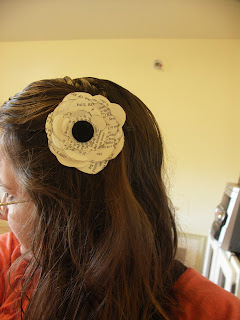
...and their very own, hand-made-by-me "Authoress Hair-Flower"! :)


 The glory, honor, and homage part comes from the fact that the top three winners (one from each category) will get their entries posted on this blog (as long as they agree to it.) and the Grand Prize Winner will get to do a guest post here on The Inkpen Authoress! :) So keep the entries coming girls! And if you've forgotten all the details, just click on the contest button on the side-bar and read it all where it takes you. :) ~Rachel