Showing posts with label vintage. Show all posts

Saturday, January 17, 2015

The Quintessential Mystery Novel


(This post originally showed up at Vintage Novels on November 7, 2014)


The Quintessential Mystery Novel.

The Unfathomable Case And The Clever Means By Which It Is Solved.

The Joy Of Having A Watson.

These things belong to the Golden Era mysteries.
Not that I have read so terribly many mysteries in my lifetime, but I have dabbled in the genre as a reader, and I’m entering it as a writer. Through my experiences, I’ve come to the conclusion that the Golden Age of the Mystery Novel was dubbed so for a reason. I have read and enjoyed some mysteries written by contemporary authors. Funny thing is, the setting always pre-dates the late 1940’s.
What on earth makes the Golden Age authors so much more to my taste than the modern writers? What key did they hold to unlock the joys of the mystery-genre for me? How can I feel that Lord Peter Wimsey and Sherlock Holmes were real people, while I have a hard time suspending reality to get my thoughts into the story-world of the modern detective? There is a certain measure of the Watson in me, or, as A.A. Milne described it, “A Watson, then, but not of necessity a fool of a Watson. A little slow, let him be, as so many of us are, but friendly, human, likeable.
These questions bring to mind the words of P.D. James, a modern mystery writer who has made a respected name for herself in the genre:
“What we can expect is a central mysterious crime, usually a murder; a closed circle of suspects, each with motives, means, and opportunity for a crime; a detective, either amateur or professional, who comes in like an avenging deity to solve it; and, by the end of the book, a solution which the reader should be able to arrive at by logical deduction from clues inserted in the novel with deceptive cunning but essential fairness.”
The latter part of this quote is where I find the charm of the Golden Era novel: “...which the reader should be able to arrive at by logical deduction from clues inserted in the novel with deceptive cunning but essential fairness.”
Between the covers of a Golden Era novel, I can expect to find all the material I need to decipher the puzzle for myself. Which is important, because I do tend to be “a little slow, but friendly, human, likeable.” Indeed, I sometimes look crossways at Sir Arthur Conan Doyle because he so often broke that essential fairness principle. “Why yes, I could certainly have guessed the murderer from the mud on his boots if you had told us there was mud on his boots.” Nevertheless, Conan Doyle (whom we acknowledge is pre-Golden-era), Dorothy L. Sayers, Agatha Christie, G.K. Chesterton, and many others in their day managed to create something spectacular in the mystery novel: a genre that has borne the traces of time well, and shows no sign of fracturing.
My new mystery, Anon, Sir, Anon, was actually inspired by picking a random book off the library shelf. When I chose to read P.D. James on Detective Fiction, I really had no idea that the Vivi & Farnham series would be born. But at the end of that intriguing book, I had a detective character, a burgeoning plot, and pages of advice, quotes, and tips on writing a British Mystery. In a way, I had done my research before knowing what I was up to. Without that little volume, behind which is the considerable wisdom of P.D. James, I would have been at a loss over the essential components of a classic mystery. Armed with her words, I was able to try my hand at this most tantalizing of genres and I am pleased with the unexpected brain-child that resulted. I would not have succeeded, however, without keeping in mind lessons I’ve learned from the Golden Era writers.
Dorothy L. Sayers taught me that the story world must feel enormous. Perhaps what I love best about Sayers’ Lord Peter Wimsey stories is the breadth of experience and education in his character. You feel that, while he is dealing with a mystery, his life encompasses much more. Sayers gave him friends, acquaintances, family, money, the ability to travel, a fabulous education, war-experience, humour, class, fashion-sense, an eyeglass. Never once in the stories does the reader feel that the investigation  is all there is to Lord Peter. In fact, one can almost get a sense that he toys at it on the side, and his real occupation and attention lies elsewhere. As my friend, Jennifer Freitag has it, “An old sleight of hand. The suggestion of more beyond.” All the best Golden Era novels have this dual tone of minute, country-house introspection, and far-reaching, grand planes of intellect and experience beyond the pages of the present novel.
Agatha Christie taught me to “gently seduce (the reader) into self-deception.” No one ever said that the same set of initials belonging to one suspect (thinking of Christie’s The Mystery of the Blue Train) couldn’t belong to another heretofore unsuspected character. I tried employing a similar trick of self-deception in Anon, Sir, Anon and was delighted to find that most of my beta-readers swallowed it hook, line, and sinker The simplest bit of redirecting the reader’s attention will often have them snatching at gnats while the real deal goes quietly on in the background.
G.K. Chesterton taught me that nothing is too absurd to be impossible. The craziest solution imaginable? Sometimes it’s right. Common sense only goes so far in an official investigation and the more creative your detective, the more complex and ridiculously “I should have seen that coming” your solution can be.
Sir Arthur Conan Doyle taught me that a Watson figure is indispensable. A.A. Milne (whose Red House Mystery I adored) addressed the Watson dilemma in this way:
“Are we to have a Watson? We are. Death to the author who keeps his unravelling for the last chapter, making all the other chapters but prologue to a five-minute drama. This is no way to write a story. Let us know from chapter to chapter what the detective is thinking. For this he must watsonize or soliloquize; the one is merely a dialogue form of the other, and by that, more readable.”
Conan Doyle invented Watson and in doing so, helped millions of readers who, like myself, find it hard to keep up with vague hints and slip-shod clues and need a little bit of explanation. There are many ways to spin the Watson character. Agatha Christie seems to choose a new character in each mystery, while Dorothy Sayers created Harriet Vane, Lord Peter’s love-interest. In Anon, Sir, Anon, I created Genevieve Langley: the niece of the detective, Orville Farnham. Vivi and Farnham split the roles of Sherlock and Watson just about 50-50, bringing a freshness to the role.

The Golden Era of mysteries has many tips  for writers today to glean. The stories have endured, and it’s worth discovering why. Of course there are many fine contemporary mysteries, but for me, there will always something especially delicious about a vintage whodunnit in a little English town. After all, there really is nothing like a curious trip to the not-so-distant past.

Sunday, December 14, 2014

My Christmas Gift To You: In 12 Parts :)


Dear Followers of the Inkpen Authoress,
   I believe you need a good nickname but I am too lazy to think of one at present. Do you want to discuss it amongst yourselves? Too bad the term "inklings" is already taken. Lewis used all the good stuff, drat him. Anyway, what I meant to say is that Christmas is most definitely coming and, including Christmas Day, there are twelve days left until that beautiful holiday. I just returned from a trip to Washington D.C. which is always an inspiring experience...and because of several things that transpired there, I have decided to write you a Christmas short story in twelve parts. I'll post the continuing story each day and all you have to do is drop by and read the daily dose! This will not only be a treat for you, but a good method by which I intend to get some non-novel writing in for the holidays. Thus I give to you:


John Out-the-Window
by Rachel Heffington


Letter the First:


December 14, 1948
Dear Mavis,
It is twelve days before Christmas and my true love has given me nothing. I wish I had your cynicism and could stop checking the mailbox but I can’t. I have been down three times since four o’clock and it’s still as empty as ever. I keep hoping the next trip will bring a Christmas package from a secret admirer but apparently have no admirers, secret or otherwise. The P.O. closes at five. If I’m to have a True Love Gave To Me, he has but fifteen minutes to give me the post-war equivalent of the requisite partridge and pear tree. A cornish hen at the Ritz might not be scorned.
You said in your last letter that I should stop being romantic and chuckle-headed and Do Something with my life. I do admire people like you, Mavis, who have backbones and believe we women can do any of the jobs men can. But I have a confession that you probably won’t be overly surprised to hear: I am a lazy creature. I do not want the exertion of doing what it takes to be a feminist in this era. Rosie might have enjoyed riveting but I have no upper arm strength and I hate the smell of brass. I wish I was clever and could write like you but I’m good for nothing but helping femme fatales into and out of gowns at fittings and checking my mailbox four times an hour. Lazy, as I said.
Say. He has exactly three minutes to show his head. I’ll dash down at five after and try to convince Mrs. Simmons I was on my way out and not stalking my box for a partridge in a pear tree. This will obviously require my actually going out which means I’d better write like crazy now and finish up later. Should I go out for coffee or doughnuts? Both I should think, if old True Love Gave To Me disdains to leave a package.
I am sorry to ramble, Mavis, as I know it annoys you to no end. Let me try to practice pessimism. Ahem.
My mailbox will be empty.
I will not have a true love (What’s new?).
I will still have to go out so as to confuse that Amazon, Mrs. Olivia Meeks Simmons.
Lord help me. How dreary it all sounds. Five-o-five. Off I go with my warm mittens on and my overshoes and my new red coat. It is a very nice coat. Very Mavis-esque. Cheers!

**8:35 PM**

Oh HEAVEN-CLOUDS. Oh Christmas. I don’t know where to begin except this: my mailbox was NOT EMPTY when I went down at five-o-six. The way I knew this is because Mrs. Simmons swirled around in her chair and offered the mail to me on a salver. Actually, Mavis, she chewed her wrinkled finger (are there any nails left to bite?) and snorted like a windy plow-horse.
“You kin stop playin’ relay-races with yourself, if you’d like. They shore as called the game and t’other team won.”
I believe Mrs. Simmons thought herself humorous.
I barely heard, for I saw a squatty, chubby, brown-paper package with a red ribbon snuggling in my inhospitable mailbox. I reached for it and Mrs. Simmons snatched it up. You will be able to understand why I did not laugh at Mrs. Simmons’ joke. I almost regret my negligence in not making humored noises, for it made her cross.
She would not give up my mail! I had a perfectly reasonable panic that I would never get the package at all.
I am afraid at this point that I said a number of cutting things about postal regulations and obstruction of justice. Perhaps mail does not have much to do with justice on a legal level, but personally, I believe it  is one of life’s vital pleasures. Take away the post and you might as well cut off my legs at my ankles, which are rather nice.
I wrestled the package away, charged out the front door, and promptly ran into a huge man in a frosty overcoat. He could surely not be the sender of this package. He was immense! But the collision knocked said parcel to the corner of the sidewalk and quite flattened the dear little bow.
“Oh!” I squeaked. You will remember how: with a little angry jump at the end.
The man bowled forward and chucked the package back at me. I have always been awful at sports and even the most elementary games of catch. Tonight was no different. The package landed at my feet and sent snow down my ankles. I only pray there is nothing breakable in that ill-fated parcel.
Yes, do raise your perfect Left Eyebrow, Mavis my friend. I have not opened it. I stuffed the offended item into my coat pocket and blundered my way to the shop on G-street where they make terrifying coffee and angelic doughnuts.
I ate three. My figure is funeralized.
When I had blundered around a little more, I tramped home and shoved the package on top of the register where it ogles me now. Mavis, I’m scared into a state of rigor mortis. I have never been a brave person, as you know, but now I’m really and truly frightened. I never really thought there would be a package in my mailbox on this first day of the Christmas Twelve. That’s why I didn’t bother trying to be cynical about it. But now there is a box without an address in my possession and it belongs to me.  I think. And it is at present goggling at me from the register.
I can’t bear to open it.
This letter is wretchedly long.
What if this gift is from someone I know? I hate the men I know.
Or what if it is from the enormous man in the frosty coat?
What if it turns out to be cordial cherries, which I despise? I shook the box just now. It sounds like cordial cherries.
You see the complexities of unwrapping the box, Mavis dear? But...oh goodness. I know it is time to be a logical girl and do what you would do: open it straight away.
Here goes.
**8:54 PM**
Oh, it’s a perfectly lovely gift! A gold brooch shaped like an espalier-tree with a tiny pearl dove in the top, though I expect it’s meant to be the elusive partridge. Of all hateful human beings, I do think men are the worst. Mavis, it’s all wrong.
I opened the box and my stomach crinkled like wrapping paper and my face flamed, it was such a lovely pin. Then I notice the card inside:
“To Diana:
    They were out of live partridges and anyway, I’ve heard they scratch. Please take this gift as broad hint of my admiration. I remain yours,
        John Out-the-Window”
My stomach flattened out. My cheeks cooled. It isn’t a gift for me after all. I am Toni, not Diana. And it’s no good trying to winkle an alternative meaning out of it. I’ve tried:
Is Diana the woman’s name?
Or does he reference Diana the Huntress?
Even if he is referencing the mythical Diana, how am I to be sure he means me, a girl who might more honestly appropriate Catherine of Russia as an adopted title. Besides. I know no John Out-the-Window.
I am taking myself to bed. Life is terrible. I knew I should never have opened that gift. I despise Mrs. Simmons and her non-fingernails. Tomorrow I will try to find the Diana for whom the gift was meant. Aren’t I heroic?
Yours,
    Antoinette Charleton

Sunday, February 16, 2014

Callie-inspired DIY Retro Makeup Tutorial & Giveaway

Lame as it sounds, one of the things that first inspired "How About Coffee?" {the short story that inspired Fly Away Home} was my love for the fashions of the 1950's. The whole culture was exciting, glamorous, and the perfect place to put a girl like Callie. But it all began with me loving red lipstick. I'm quite serious about this. I guess my love of red lipstick started with loving old movies and fashions and then it kind of blossomed from there. My own personal style is a sort of romantic-retro-chic and so all these bits all slid in without a problem. I knew when I started planning the Fly Away Home debut party that I wanted to include a post on Retro Makeup and I thought, "Why not make it a tutorial?" My younger sister, Anna, allowed herself to be commandeered for a model. She would like me to herein state that she did nothing with her hair so I could mess with it later. Hence the straw-man effect. ;) (I may or may not have chosen her because she has perfect retro-lips. That's my one complaint about red lipstick on me: I don't have the "cupid bow" going on.) First off, I'm going to give you a quick run-down on the basics of creating a retro look: 
  • Matte eye shadows
  • Sleek, shaped brows (often darkened with a pencil)
  • Adventurous matte or creme lipsticks, mostly in reds, burgundies, and red-oranges.
  • Lighter face powder and blush - tanning was not what glamour-queens did on weekends

What you'll need to recreate this look:


  • A matte palette of eye shadow (I used Rimmel "Romantic Cool")
  • Black liquid or gel eye-liner
  • Black eye liner solid
  • Black mascara I use Rimmel "Glam Eyes"
  • Your usual face-powder/foundation (I have no idea what Anna uses. She came pre-powdered)
  • Lip balm of some sort to moisturize lips
  • Red/dark pink lip-liner
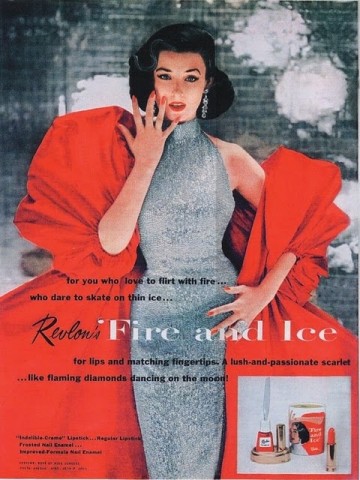
  • Red lipstick or color of choice (I went with Revlon "Fire & Ice" which is more scarlet than red)

Great! Once you've got all this stuff laid out, prepare your face or your model's face by applying the foundation/powder/blush etc. I ought to use this stuff but I don't. I can't imagine how expensive it'd be to keep adding facial products so though I will cave someday, I stick with eye-makeup and lipstuffs. I have good color in my face so blush isn't really important for me. 

(We are discussing Anna, though)

(Nothing but face stuff right now)
 I'd say the real key to a retro-look is making sure that all your makeup is matte-finish. They weren't so much into the glossy stuff in the 1940's and 50's. My Rimmel eye-shadow has a little glimmer in it, but I opted for that over my brown palette because Anna has a paler complexion and brown would wash her out too much. The "Romantic Cool" palette is more delicate and better suits her.

Apply your neutral tones to the eyelids as you would on a normal day.


Next, you are going to apply a careful line of the liquid eyeliner. This is a little trickier than it looks: toward the inner corner of your eye, make sure the line is super slender. Let it thicken toward the center and continue thickening till the very outer corner. Before continuing all the way to the very bottom corner of the eye, do a little flick for a "kitten-eye" effect. Now you'll use your solid eye pencil and outline the bottom lid, drawing into the liquid-liner flick.


Apply mascara freely to eyes. The thicker the better for the retro look! A good way to get the mascara to look thicker than it really is is to put an extra coat or two starting from the center lashes and heading back toward the outer edge. This gives it a "butterfly" effect that is essentially flirtatious. ;)

Eye makeup finished!
 Next step on the tour is the lips! Moisturizing your lips before trying to apply liner will save you a ton of headache. Once you've done that, outline your lips. Obviously for Anna, I didn't have to go outside of her lip line, but if you don't have a nice "cupid-bow" you can very slightly tease the shape out of your lips by drawing your "peaks" just a little bit higher than what is natural. Changing your lip-shape is a risky business so go very slowly; lip-liner doesn't like to wash off. :)


Once you have applied the red lipstick, kiss it off once or twice on a paper towel to insure it doesn't travel, and you're good to go with your silver-screen glamour-queen look!


Fun Fact:


Revlon launched an adventurous lipstick campaign in 1952 (the year in which Fly Away Home takes place!), catered toward "...you who love to flirt with fire...who dare to skate on thin ice...". The campaign was called "Fire and Ice" and was a hit. In face, "Fire and Ice" is one of the specific shades of lipstick Callie uses in Fly Away Home and guess what? They make a version of it today. In fact, that is what I used on Anna for the tutorial. Would you like to win a tube of Revlon "Fire and Ice" lipstick to bring out your inner glamour-girl? Leave a comment with your email address and at the end of the week, Anna will draw one name out of the lot to win a tube of that "famous" lipstick!

On the same topic of giveaways, there is certainly still time to enter the giveaway to win 2 autographed copies of Fly Away Home here on the Inkpen Authoress, and I am pleased to announce that Leah E. Good   reviewed and is giving away a copy of my book on her blog! Lots of things to win, darlings! Don't you want to try?
And, in keeping with the blog tourishness, visit me over at:
Just As I Am
Scribbles and Inkstains

Tuesday, September 27, 2011

How About Coffee? --a short story

   Hey guys! Here's a scribble I wrote down this morning! :) It came to me while hanging up laundry...I often start a random dialog with myself and am quite witty...pity that never happens in *real* conversations. ;)

"How About Coffee?"
         By Rachel Heffington
  "I will admit I had expected to find a man of your fame and social standing a bit more...complicated." Miss Harper raised an eyebrow and sighed, relieved to have the confession made.
     He chuckled and leaned forward with the boyish, eager expression that always caught her off guard."You mean you hadn't thought to find me a man of simple wants and pleasures?"
     Yes, that was it exactly--a man who could be satisfied with feeding pigeons in a city park was an oddity. She smoothed her skirt and shifted. "Tell me, Mr. Barnett, how do you endure the pretension, the shallow and petty motives of Society?" There was bitterness in her voice, and he observed her with a quiet compassion in his eyes.
     "I never asked for fame and fortune--I never sought," he said. "I am a mere whim of these people: here today, gone tomorrow." He moved his fingers as if sprinkling chaff to the wind, then smiled. "Why should I care for the opinion of Society when society chose me itself? Let it raise me and lower me as it will. I am the same man it found me at the first."
    Miss Harper contemplated him in wonder. He was transfixing, this man. Not handsome, but one never thought of that fact. He had everything she so desired: fortune, fame...friends. Yet he spoke as if he rather longed for the distant days of obscurity when--as she recalled him telling her--he'd lived in a shabby flat overlooking a prison yard.
    She cleared her throat and pinched her lips together before speaking. "Mr. Barnett, let me make something very clear."
    He nodded and raised his eyebrows, that puppyish furrow on his brow bringing a slight upward curve to her mouth. Her manner softened the tiniest bit. "I can guess why they chose me. It isn't because I've got talent or brains--it's so that if anything goes wrong with this project they can blame me and keep your precious reputation untainted."
    He was hurt--she could see that and she wished at once she had kept her mouth shut. But Mr. Barnett only toyed with his necktie and fixed his gaze on the the painting of Washington crossing the Delaware. He stole a few doubtful glances at her face and was silent. She tucked her hair behind her ear and touched his hand with a her tapering fingers. It was warm and real beneath her cold fingertips. How she wished some of that radiant life would ebb from his vibrancy into her own chilled existance.
     "I'm sorry, Mr. Barnett. I shouldn't have--"
     "Do you have so low an opinion of me that you think I would let them blame you?" His voice registered no anger, only sorrow that she thought so ill of him. "You think I would allow my mistakes to injure the reputation of an innocent person? Hang my reputation and social standing. I'd rather live in a slum than live as a dishonest scoundrel!" He was perfectly in earnest--every inch of him. His wiry blond hair flew every which-way and his grey eyes snapped blue fire.
     "I didn't mean it to sound that way, sir," she said, throwing her hands up in the air and wishing he wouldn't look quite so desperate about the matter.
     "But you thought of me so. Oh, Miss Harper, if you only knew how much I--" Mr. Barnett sprang from his chair, clapped a weather-stained fedora onto his head and shoved his arms into his coat. "Come on."
     Miss Harper leaned back in her chair, marvelling. She had always favored handsome men, and this man was plain at best. She was not in love, she assured herself. Impossible, and what's more, improbable! Yet that foreign smile hovered over her pretty, pouting lips, and as she stood to put her own coat on, she caught Mr. Barnett's eyes, full of anxious solicitude. She laughed aloud.
     "Then you aren't angry with me?" he asked with his customary frankness.
      She shook her head, cheeks burning, eyes shining. Mr. Barnett cracked a grin and cautiously offered her his arm. She stuck a pin through her hat and took the shabby-coated arm with a shy smile. Mr. Barnett swallowed, his cheeks red and shiny as two good-natured poppies. He tried his voice once, then again. At last he threw the office door open to a pelting rain hammering the sidewalk beyond the awning. He raised his umbrella and led her outside where they were at once enveloped in the wet chorus of New York City in a rain storm. A cab flew by, splashing mud and water over Miss Harper's black stilettos.
     "Oh dear." Mr. Barnett drew her closer to his side and stared at her shoes in dismay.
     "Don't worry about it." She smiled reassuringly and laughed again, enjoying the strange exhilaration it brought. "But where on earth are we going?"
      He shrugged and the gradual sideways spread of his grin began. "How about coffee?"