Showing posts with label book reviews. Show all posts

Monday, March 28, 2016

The Red Shooter Hat

see? i identify with this. 

I don't know why, but when I read a classic book I usually seem to get hold of it by the wrong end. I don't go to misinterpret or to catch a different meaning than everyone else, but somehow I do. When I read, I let the story carry me. I let go of analysis until I have finished the book. Its effect on me usually remains to be seen until the final pages are gone. I don't know how to analyze as I go. And even if I did, I think I would get caught in the current of the story and forget to. When I was younger I used to grow frustrated that I couldn't foresee the solution of a mystery when my brother, bless his soul, could guess in three pages who had done it and how, and possibly in which room. Then I grew older, and it frustrated me (and still frustrates me) that I seem to interpret books differently than the official analysis. Take, Go Set a Watchman by Harper Lee. That book made critics throw back their heads and howl with pain as Lee allegedly ripped the character of Atticus as we know him, to shreds. When I read the book I was disappointed in Atticus, yet Lee had built her characters and story-world well enough that the shift in conviction didn't exactly ruin Atticus for me. It made him even more real...because he has a (very large) flaw that one didn't see in To Kill a Mockingbird but that one could believe given his age and times. There is an argument to be made for the idea that Harper Lee didn't intend the version of Atticus seen in Go Set a Watchman to be the Atticus the world knew because, after all, she published TKAM and Atticus mightn't yet have been in his final form in its prequel. There is that argument (I spent some time this weekend arguing the point with the aforementioned brother) and that is a topic for another post. But the fact remains that I didn't react the way the majority of the public reacted to Go Set A Watchman.
Likewise, upon strength of recommendation from a friend, I dived into J.D. Salinger's work this week. He is best known, I believe, for The Catcher in The Rye. I've read that and am now halfway through Franny & Zooey. Since I entered Catcher not knowing anything about it, really, except that it was generally regarded as something People Should Read, I had no preconceived notions about what it would or would not be. My initial reaction was that Salinger is a darn good wordsmith. The best way I can describe the way his writing effects me is that it feels like soda bubbles up one's nose. It's unexpected and fresh and totally different than most anything else I've ever read. My second reaction was that I, too, could write like Salinger if I replaced all my adjectives with swearing. My third reaction was that Catcher's main character, Holden Caulfield, was a boy who'd grown up too fast. His morals are questionable at every turn, but his heart is gold. I know that sounds like an anomaly. Perhaps it is. But what I saw in the character was a boy who has rushed headlong into the world and its many pleasures and yet finds himself confused by the hollow chaos and unsure how to handle how he feels about it. He is kind-hearted. He is smart. He is empty. He is generous. He has known tragedy and he has known happiness, in some small way. The kid's winded, that's for sure. He's going to kill himself presently if he doesn't get a grip, but I had a soft spot for Holden Caulfield.

Thus ran my mind as I closed The Catcher in The Rye and totted the name on my List of Books Read in 2016. Later on I looked up the book online to see what the GP (General Populace) thought of it and found that, apparently, I took away the wrong takeaway from the novel. It is reputed to be a manifesto of teen rebellion; the most censored book of the baby boomers' era; the mental ramblings of an obsessed kid; an inspiration for several shooters, including John Lennon's killer. And I swear to you most earnestly, I can't figure out why on my own. Once I looked up a couple articles, of course, I saw what they meant...if you're an over-thinker and like to overthink things. I mean, if you want to think hard enough about a grape, I guess you can decide it's a raisin and you wouldn't be wrong. You'd just be scrutinizing it past the point of good sense. Or maybe my difficulty is that I don't scrutinize much at all. I'm perfectly happy, if it's a good story, to take the story at face value. I like discussing deep things and ulterior motives and various interpretations, but I'm what Shakespeare would call a "pleasant-spirited lady" and I don't like assigning sketchy backstory to people helter-skelter. I'm more than willing to believe you are what you appear to be, until you give me a reason to think otherwise. I mean, take Holden Caulfield. Yeah, he's an emotionally unstable person given to hyperbole, but you don't exactly go around asking people if they're mad, do you? My problem is that characters become very real to me and I treat them, subconsciously, as if they were real acquaintances. I can imagine my friendship with Holden Caulfield going this way:

Me: "Hello, I'm Rachel."
H.C.: "What're you *%#% introducing yourself to me for?"
Me: "Oh, I thought you looked lonely. It's a little cold out here. Want to step inside?"
H.C. looks at me and shrugs.
Me: "Let's go."
We step inside, camera shifts, H.C. shudders some rain off his coat.
Me: "That's a dashing hat. Very red."
H.C.: "Why the &$#@$@ does everyone comment on my hat? Isn't a fella allowed to wear a $%#$3 hat every once in a while if he wants to?"
Me: "Well, it's a very nice hat."
H.C. begrudgingly: "Gee, thanks."

I'd come away thinking that H.C. was a bit of a crab, had a great many peculiarities, but was probably a fairly nice person on the whole. I wouldn't sit there and psychoanalyze him and start getting a pathological fear of people who wear red deerstalker hats and try not to go home so they won't get into trouble with their parents for flunking out of yet another school. I mean, don't get me wrong: Holden Caulfield has problems. But I think I'm the one about to develop a paranoia of letting madmen go undetected. The really disturbing part is when, like with the quote above, I identify with the supposedly nut-so character in question.

I hate the fact that I don't pick up on subtle cues in literature. I'm not a great one for symbolism. I like people to say what they mean but I don't mind if it has two or three meanings. I like complexity. But I'm also not going to assume that when you put a character in a red hat he bought in New York City, that he needs a psychiatrist. I mean, give a man a sartorial break. At any rate, this is why I don't do book reviews on my blog; I always seem to come away with quite a different impression than the author intended and I'm not sure what that says about me. So now I want to open up a discussion and ask you: are you one of the dedicated G.P. that foresee the psychological conclusion of a character like Holden Caulfield or are you more like me: a woman a bit shy to clap the shackles of a sanitarium on a person who hasn't proved himself in any concrete way to be a total loony? 

Monday, March 14, 2016

Eleven on the Eiffel Tower


Hey, Guys! Last Monday I was not at all in town (Tampa is a beautiful place to spend a March Monday), and this Monday I'm late with the post, but I'm definitely posting, so that's something. I did a lot of talking-about-books in Tampa. The friends with whom I stayed are the sort of people who have read widely, who laugh at my affinity for the 19th Century British Novel, and who are able to suggest improvements to my course of reading. I've been told to read Crime And Punishment as soon as possible and to follow it up with some J.D. Salinger ("All of Salinger is great - he only published four books."). While in Tampa, I had the chance to go to Oxford Exchange - probably the most pretentiously-hipster place I ever hope to set foot in. There was, of course, an entire section devoted to books and I did, of course, have to buy at least one. I chose a creative's travel-guide to London in preparation for my trip next year and a newish French novel - The Red Notebook by Antoine Laurain. I'm not saying the latter choice was the most groundbreaking literature ever written (it was a simple, sweet, predictable, very enjoyable story), but I loved it. Sometimes, you know, you just want a book that does exactly what you hope it will do. The Red Notebook did that. I got so lost in the book that I momentarily forgot I was in Florida at all and had to blink round for a moment or two before I realized where I was.

Perhaps my favorite part of Oxford Exchange was when I checked out at the desk with the preppy fellow in glasses. He slipped the titles across the desk to himself, palm down. His mouth quirked in a smile as he read the titles.
"London...and Paris....which will it be?"
I laughed. "Going to London next year."
"But why not go to Paris too? I mean, you're already over there." He announced my total and leaned on the counter. "You can take the tunnel or something."
I couldn't not let my cracking-grin out. "Have you been?"
"Yeah. When I was twelve. I wish I remembered more of it. I'm sorry I can't give you recommendations."
"That's all right. I want to go to the Eiffel Tower at eleven o'clock at night." I don't know why I told him that, but it wanted to be announced."
He grinned. "Yeah? Why eleven o'clock?"
"Oh, I don't know. I think it'd be prettiest then. The city might be a little quiet. The lights would all be out. I might have it more to myself."
He tossed his head and laughed. "I bet everyone has that idea."
"Yeah, probably."
"Well, hey, eleven o'clock's all right, but you don't want to be out in Paris after midnight. They say strange things start to happen."
"Is that so?" My mind swirled around and caught hold of his reference, tugging me back to the surface. "Right - well, I think I'll be all right as long as I don't get into any old cars with dead authors."
He beamed. "Exactly - you know, the movie?"
"Yeah! Midnight in Paris." I mentally blessed that random film choice on a Russian airline and turned to leave. "Have a great day."
"You too! Enjoy London and Paris!"

Another bright book-realm moment of the trip was talking home-libraries with one brother and seeing the personal library of the other. So many beautiful hard-bound editions. Such a wealth of knowledge in one location. Do you ever feel like that? Like if you could just make it through the entirety of the shelves (even of one small personal library) you'd be about twice as smart as you currently are? I do constantly. And it's a hopeful thing, you know, because there's always a chance you'll stumble upon some stroke of genius in a yet-unread book.

I've also been inspired recently by something I'm hoping to turn into at least a piece of flash-fiction if not a short story. If I'm really ambitious it could make it into a novella sized story, but we'll see. For now, know that I'm reading Henry V cozily, thumbing again through Chesterton's Orthodoxy as I feel like it, and putting Crime And Punishment on hold at the library. Ho for expanding one's mind!

What are you reading, and do you have any recommendations for really good modern fiction?

Monday, September 29, 2014

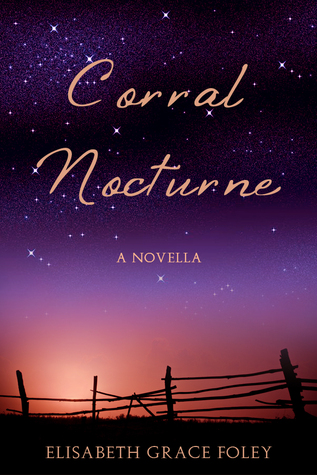
Presenting: Corral Nocturne by Elisabeth G. Foley

While we are all waiting eagerly for Anon, Sir, Anon to enter the public world on the Fifth of November, there are several other books in the wings that I find somewhat abate my sense of "NOVMBER FIFTH MUST COME NOW." I have already mentioned Jennifer Freitag's Plenilune which descends October 20th, and today it is my pleasure to recommend a sweet, fresh novella: Elisabeth G. Foley's Corral Nocturne. Foley has earned my respect and admiration in many ways and her newest novella, due November 1, 2014, further cemented my satisfaction. Please add the book on Goodreads and, as always, if you are given the privilege of reading a book by an indie author, do them a favor and review it when you've finished. We may call ourselves independent, but we really rely on ratings to help spread the word. 

Also, the cover is gorgeous.


Having enjoyed Elisabeth Grace Foley's Mrs. Meade Mysteries Vol. 1, I was quite prepared to enjoy Corral Nocturne, but I wasn't certain how the author would effectively spin a Cinderella story out of prairie grass and homespun. I shouldn't have been worried. The mark of a good writer, for me, is that they have consistency. Foley is nothing if not consistent. From her mysteries to her blog posts to Corral Nocturne, Foley knows her stuff and writes it effortlessly. Most experiences I've had with Westerns has come from watching the old black and white films, by which I mean that I am not terribly "up" on the Western setting. Enter Foley, with her gentle descriptions that show me the beauty of the West and the tenacity of its people and explains, without seeming to explain, the genre.
Elisabeth Foley has a way writing rich settings: stories set in places where you can see the story world reaching farther than the bonds of this book. Corral Nocturne, while being a lovely Cinderella-style story (and yes, she managed it!), also gave me a sense of wanting more. I would love it if Ella and Cole had had more time together, for their relationship to grow. In fact, I would not have minded spending an entire novel with them and getting to know the people mentioned in passing. That being said, if you enjoy a quiet, gentle romance by the rose-purple light of a prairie dusk, read Corral Nocturne. Do

Saturday, August 30, 2014

Wallaby-Wise


You have probably heard via my Facebook page or Twitter, I finished editing Anon, Sir, Anon on Thursday morning. There is one scene yet to finish (the fencing scene. I have my "terminologist" looking it over.) but for the purpose of saying it, Anon, Sir, Anon is thoroughly edited. Thursday afternoon, swept into the glory of having finished the actual book, I sat down and finished my map of Whistlecreig. I am making attempts to get the map into the print copies of the book, but if it turns out too complex to shrink to size, I will content myself with giving it space on a page on The Inkpen Authoress for those readers who want a closer look at Whistlecreig Manor & Environs.


In other news about Anon, Sir, Anon, I am pleased to announce that the official cover-reveal date will be released this week and there are at least

Two new reviews: 

The climax is spectacular. Surprising, deliciously suspenseful, and avoiding the common pitfalls that authors fall into. Rachel held just enough secrets from me so I could enjoy the suspense--and then, when the moment came for boldness, carried it off with aplomb. Bravo; well done!
(WARNING: one advanced reader left quite a lot of spoilers in the comments section so don't read comments unless you want to know everything about the book.

This little murder mystery bears all the things I've come to expect from Rachel's books: crackling wit, gloriously well-crafted prose, and quirky, lovable characters. On top of that, the plot was more tightly woven and credible, the character interactions flowed better, and the writing--though I was reading a version which had not yet been polished by an editor--is patently more colourful and compelling than in her other works. In addition, there's a streak of something a little darker in this book. From the plight of the victim, to the identity of the killer, Rachel Heffington proves herself ready to make hard authorial decisions.
Think you'd be interested in my mystery? Add the book on Goodreads and "Remember, remember the Fifth of November." I can't get over how helpful my subconscious was in choosing a release-date so memorable. ^.^ Thank you, latent brain of mine. And, because I'm nice that way and want to tempt you with bits of my "patently more colourful" writing, here are some of those snippets I promised an age ago:

Skirts and bicycles were certainly an invention of the devil’s wife. If it wasn’t the questionable modesty of hitching one’s skirt up to one’s thigh, it was the constant peril of being flipped stockings-over-collar off the front of the thing.
-Anon, Sir, Anon

“Bad things happen in bad weather.” Mr. Owens turned the hat he’d removed round and round and round in his hands and the mist dropped off in pewter slips.
-Anon, Sir, Anon

She took him in, studied him, turned him in her mind like a wooden doll to be examined at leisure.
-Anon, Sir, Anon


“The luggage...” Vivi pressed her fingers onto her eyelids to ease the headache that had advanced on her with the dusk. “Where on earth is it? It must be in the murderer’s possession.”
“High marks for effort, Harriet Vane, but you’re wrong.” He cast his still powerful frame into a chair and knocked on the table with his knuckles. “She left it at the station and said she’d send for it later. The police have it now.”
-Anon, Sir, Anon


Farnham drew his head back into the dining room and squinted at the pale moon-face of the grandfather clock. Eight thirty-ish. No, wait. Half-seven. He rubbed his eyes and glared at the stiff black hands. The last thing he wanted was spectacles.
-Anon, Sir, Anon


On the Kettering side of the road, the stream flowed their direction in blue kinks and ripples; on the left, it ran a few merry paces before hitting the mill-wheel and resigning itself with a peaceful sigh to a rest in the mill pond. Farnham felt a bit of that peace balm his soul. He could think. He could smoke. He would be all right, presently.
-Anon, Sir, Anon


Genevieve Langley, paragon of all things mannerly, was late.
-Anon, Sir, Anon
“Such a gorgeous morning for a ride.” Vivi’s smile was bright, hurried. “Weather so obliging. Barely needed my tweeds at all, which is nice because in London I’m always tweeding and one does get tired of looking like a graham biscuit.
-Anon, Sir, Anon

She drew the word out wallaby-wise and gestured with her little hand.
-Anon, Sir, Anon

Down the curve of her cheek strode a deep shade of rose. Girls could still blush! Fascinating. He’d thought it died out with modesty some years back.
-Anon, Sir, Anon

Sunday, August 3, 2014

Book Review: Plenilune by Jennifer Freitag


"The fate of Plenilune hangs on the election of the Overlord, for which Rupert de la Mare and his brother are the only contenders, but when Rupert’s unwilling bride-to-be uncovers his plot to murder his brother, the conflict explodes into civil war.
To assure the minds of the lord-electors of Plenilune that he has some capacity for humanity, Rupert de la Mare has been asked to woo and win a lady before he can become the Overlord, and he will do it—even if he has to kidnap her."
In giving Plenilune five stars, I hope I am not doing Jennifer Freitag a disservice; I am a reader quite easy to please and I give far more 5-star reviews than some reviewers. I go into a story willing to be pleased, wooed, won by the author. But now, waiting for Plenilune's orb to come crashing into the literary atmosphere, I wish I could retrieve some of those stars from some lesser books because to give a book five stars is to give it my all and that I wish to do now.

For several years I have read Jennifer Freitag's blog, The Penslayer, and enjoyed "snippets" of her writing. I read her first novel, The Shadow Things, and while I enjoyed it, I knew that her writing had grown since its birth and was anxious to read it in its modernity. Plenilune, I imagined, was something a bit more mature than the smaller, tentative Shadow Things.
A friendship gradually sprang up betwixt Jenny and myself but still I had not thought to get to read her "opus" before publication until one day (probably overwhelmed with pregnancy hormones and the pressures of life) Jenny caved and sent me Plenilune en masse. I did not ravage it in a sitting; Plenilune is not one of those novels that calls for such behavior. Indeed, try to swallow it whole and you'll be marked a glutton with no fine taste. It ought to be read, savoured, gentled into one's comprehension because if you try to swallow a moon at one go, you'll certainly feel it a surfeit.

Perhaps the thing that impressed me most in Freitag's novel was the fact that her writing as a whole--the characters, arcs, themes, sensations--stood scrutiny as boldly as one beautiful line in a post of snippets. She can conduct small magic in a line, pyrotechnics in a novel.

I left Plenilune feeling nobler. I can't explain it any other way than that Freitag managed to reach into a fierce, crimson, hidden part of me and call forth a banner-blaze not soon to be extinguished. You will hear readers say that Freitag's work is "like Tolkien" or "like Lewis" and I daresay they mean it well. But it's not. Freitag's writing is like Freitag. That's quite enough for Jenny; that's quite enough for me. I look forward to buying my own copy of Plenilune and prowling upon her doorstep for the next installment in the Plenilunar world.

(Five of five stars. Because of the realistic dealings with characters both good and evil, I heartily recommend Plenilune for ages sixteen and older.)

Friday, April 18, 2014

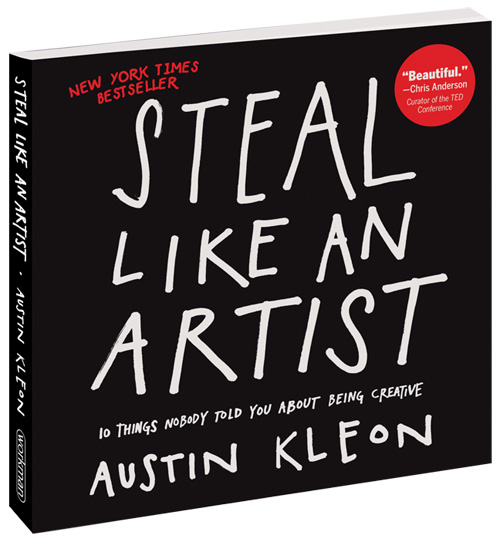
Steal Like an Artist

I don't often make a sweeping blanket statement (or did I just make one?) but today I will. Every creative person, be they author, singer, songwriter, artist, performer, or simply a stay-at-home mother with a handful of fresh veggies in a kitchen and a wish for an exotic meal should read this book:


I had never heard of it until two days ago. I had never known about it till 12:30 or 1:00 this morning when I was hanging with my older brother in the kitchen and reading the introduction. Daniel had been listening to a podcast by one of his favorite bands and the lead singer raised this book to the camera and said, "Read it."

Daniel, standing in our kitchen in the dead of night while I scavenged around the leftover yellow cake with chocolate icing, said something similar. "You should read it. I'm here till tomorrow afternoon." And you know what? There's something imminent and approachable about a book like this that makes you want to obey that ubiquitous command. Daniel didn't buy Steal Like an Artist because Mike Donahey said to, but because he knew he needed it. In the same way, I didn't go to bed at 1 a.m. and wake up at 7:30 when I could have slept in because Daniel told me to, but because I knew I wanted and needed to read this book.

I finished it in an hour.

It became a favorite in ten minutes.

And so I'm telling you, you need to read it. The thing that impressed me most about Austin Kleon's book was not the fact that it is for creative people or even the fact that it is full of cool little diagrams and witty humor. What endeared this book to me from the first chapter is the way he takes the small things in life seriously. Decisions are important. Little things upon little things do make up the big things.
"Just as your familial genealogy, you have a genealogy of ideas. You don't get to pick your family, but you can pick your teachers and you can pick your friends and you can pick the music you listen to and you can pick the books you read and the you can pick the movies you see. You are, in fact, a mashup of what you choose to let into your life."
-Austin Kleon Steal Like an Artist
This book is like common sense bottled into a volume the size of a c.d. Time and time again I'd read a phrase and smile. It's not that Kleon has come up with anything out of the ordinary. But he has created one of those books that takes the grand realm of my vague thoughts and impressions and gives form to it. That's what we creatives are here for, you know: to gather the floaty bits and give 'em shape. Everyone has floaty bits. It's only the real artists who can collect and tame them for presentation to another person.

Kleon busts myths like "Write what you know", corrects wrong opinions like "imitation is flattery", and leaves you at the last page feeling like a combination of superhuman, Kinfolk magazine, and fair-trade coffee. And then, with a smirk you can hear across the miles and through the pages, he recommends not paying four bucks for a latte when you could be saving money. Like, "Oh, not only have I written a manifesto of creativity, but your coffee houses where you feel so validated as an artist are totally stealing your pocket money. Starving artist--ever heard of it? Yeah. Starbucks started the trend."

Okay, so maybe he wasn't that blunt, but I loved it. In this little powerhouse of paper, Austin Kleon addresses the need for a day job, the value of living a really, well, boring life so you can actually get work done, and the necessity of stepping away from the computer and working analog:
"Just watch someone at their computer. They're so still, so immobile. You don't need a scientific study (of which there are a few) to tell you that sitting in front of a computer all day is killing you, killing your work ...You need to find a way to bring your body into your work. Our nerves aren't a one-way street--our bodies can tell our brains as much as our bodies. You know that phrase, 'going through the motions;? That's what's so great about creative works: If we just start going through the motions, if we strum a guitar, or shuffle sticky notes around a conference table, or start kneading clay, the motion kickstarts our brains into thinking."
-Austin Kleon Steal Like an Artist

I'm going to say it once more: "Read it." Let's see how long you can resist.


Monday, February 3, 2014

Friendships are Built on Blood {Snippets of Story}


The very first thing I want to say is that I have posted my review for Amber Stokes's brand new novel, Forget Me Not. You can read my thoughts on it here! Short version: you will enjoy it. :)

 It is time for Snippets of Story at Whisperings of the Pen. I don't think this needs explaining, but if it does, the rules can be found here. This past week was a bit bummy writing-wise a few of the days, but I do have a goodly chunk to show from January's capture so here's to lots more in February-to-come!

Vivi stopped and looked at her uncle. He gave a slight shake of his head as if to discourage further explanation of that fact. It was meant to be a secret gesture but Vivi saw  the Inspector looking at him.
-Anon, Sir, Anon
She let him boil in that kettle a moment, then graced him with a sweet smile.
-Anon, Sir, Anon
“I can’t remember what she said precisely and if a thing is not accurately presented there is ample room for misconstruction,” Vivi said.
The chief steepled his fingers, putting the points of his index finger against his nose, and stared at her over them. “And if there is nothing presented all all the answer will certainly be misconstrued. Be a sensible little woman.”
-Anon, Sir, Anon

The trio exited the police station and crammed into Dr. Breen’s car. Vivi felt weak and exhausted by the ordeal at the station; no matter how innocent she knew she was, there was always a moment where she feared something would go awry and she would be pegged a murderess. Something to do with her mother’s lessons that the guest was always right.
-Anon, Sir, Anon
The engine coughed to silence and Breen climbed out of the driver’s seat and opened  Vivi’s door with a flourish. “Welcome to the Quagmire, my dear Miss Langley.”
-Anon, Sir, Anon

The bad weather of the evening had cleared off with the springing-up of a light breeze, and cloud-tatters flitted over a half moon; the temperature was perfect for an almost-solitary walk: cold without being vampire-like. He felt the weight of Vivi’s arm in his and was glad he was there to protect her if--God forbid--the killer was still in Whistlecreig.
-Anon, Sir, Anon
“I’m your nursemaid. Shouldn’t I be monitoring your food intake?”
“Don’t be a spoil sport. I’m hungry for once in my bang life; let my ulcers scream. We shall solve this mystery and we shall solve it in a week--no more. I shall bet Breen on that.”
-Anon, Sir, Anon
But in her stomach a sparrow-fear darted up and beat its wings.
-Anon, Sir, Anon
She rounded a sudden twist and found herself face to face with a red fox. It grinned at her, brushing its tale across the grass. She took a step forward and it tensed, drawing backward but still grinning; the creature considered her a moment longer before trotting off in an auburn snoot, more cat than dog. She watched a rogue shaft of sunlight jink on the fox’s pelt before it vanished into the rowans like an amber spectre. Vivi was not frightened by the odd meeting with the creature but it occurred to her then that not everything in the Rowan Walk must needs be friendly; there were predators among the woodland folk even as there were among humans.
-Anon, Sir, Anon
“Do you keep horses?” Vivi asked as she and Farnham made their way down the mossy steps of the great house and took to the gravel drive.
Farnham stuffed his hands in his cardigan. “Do I look like I keep horses?”
-Anon, Sir, Anon
“What kind a’ ‘uman could craunch a gel’s head like that and not be a bloke? Barnaby, says I, Barnaby, he’s a nurker he is. Allus hotching about while waitin’ for ‘is train. Allus glining. He’s a rum one, that’un.”
-Anon, Sir, Anon
It was a pretty spot, Vivi decided. She liked it. The mill felt like a mother, gathering the rampant stream to her breast and hushing it with a chuckling murmur till it fell asleep in the cradle-pond.
-Anon, Sir, Anon

She watched Farnham and his hound lounge up the bank with growing apprehension. He wasn’t hurrying. He was barely smiling. But then, Farnham never did go in much for the whole amiable-expression thing.
-Anon, Sir, Anon
“That is positively morbid.”
“It’s a testament to our friendship.”
“Friendships aren’t built on blood!” Vivi protested.
Farnham braked suddenly and turned on her with a certain fierceness both unnerving and quaint. “Aren’t they? Surely you’ve never stuck that aristocratic nose in Henry V or the Bible or any history of any war in the last two millennia if you think friendships can’t be built on blood.”

-Anon, Sir, Anon 

Wednesday, August 21, 2013

Book Review: Dragonwitch

Buy it here
When fantasy-author Anne Elisabeth Stengl asked for a group of people to read advance-copies of her book, Dragonwitch, I signed up. I was a little leery of what this book might be, as dragons are frightful enough without being witches. But as soon as I read the prologue of the fifth book in The Tales of Goldstone Wood series, I knew I was in for something quite different than I'd pictured:
    Generations had passed in the mortal world above as the brothers battled and then lay still. At last Etanun roused himself and turned to Akilun. "Brother, I have sinned," he began, but the words vanished from his lips.
     Akilun was dead.
Brother-plots have always been a favorite of mine, so knowing that Dragonwitch started with a few pages that almost made me cry definitely set the tone for the rest of the novel.

The description from the back of the book:
     Submissive to her father's will, Lady Leta of Aiven travels far to meet a prospective husband she neither knows nor loves - Lord Alistair, future king of the North Country.
     But within the walls of his castle, all is not right. Vicious night terrors plague Lord Alistair. Whispers rise from the family crypt. The reclusive castle Chronicler, Leta's tutor and friend, possesses a secret so dangerous it could cost his life and topple the entire nation.
     And far away in a hidden kingdom, a flame burns atop the Citadel of the Living fire. Acolytes and priestesses serve their goddess to the limits of their lives and deaths. No one is safe while the Dragonwitch searches for the sword that slew her twice...and for the hero who can wield it.
It is a rare book that I actually like more than I hoped, for too often I have a higher expectation of a book than it actually merits. But with Anne Elisabeth Stengl's Dragonwitch, I found wrenching, beautiful allegories thrown in amongst the characters in an effortless way, and though I had never read a Goldstone Wood tale before, I hope to have the chance to visit the Wood Between the Worlds again soon.

What I liked about Dragonwitch:

Etanun's story, and the portrayal of Hri Sora, the Dragonwitch herself. I don't think there is a finer portrayal of goodness-gone-sour and though I despised the Hri Sora, my heart broke for her. I also have a fondness for The Chronicler, and Mouse. Funny, because they don't end up together, but they were my two favorites. And of course Eanrin, the Cat-Man; how can you not love him? Does anyone else picture him as played by Kenneth Branagh? :D
I also loved the way the author wove Truth all through the pages; like I said: sometimes I felt like I was reading a beautiful allegory which is a mark of fine writing, in my opinion.

What I didn't like about Dragonwitch:

At the beginning I didn't know Alistair well enough to care about his night-terrors, so I was more impatient than sympathetic when he would wander about in a clammy daze; however, afterward I grew to love Alistair, so I don't think the sudden introduction of his dream-problem had an adverse effect in the end.
Also, for the first third of the book I felt confused over which world was which, who was who, and had difficulty remembering names (i.e. to the new reader, "Etanun" and "Eanrin" are easily confused). But I believe this has far more to do with the fact that I'm jumping in on the series with Book 5 and would not have that confusion had I started where one is supposed to start.

Final words:

Read Dragonwitch. Read it twice. And then pass it on to your friends so they can read it. While not quite a challenging read for an adult in terms of dialog and theme, it is a beautiful book to pass a week of rainy evenings with, and you will find therein much to love, admire, and ponder. I give Dragonwitch 4 out of 5 stars. (I rarely {if ever?} give any book 5 stars if that gives you an idea of how good I think it is.)

Quotables:

   "The little man swallowed, his jaw clenching. 'This...this is the Haven of the Lumil Eliasul. The Haven of the Prince of the Farthest Shore. Built by the brothers Ashiun.'
    'Well done, Chronicler,' said Eanrin. 'You've done your research.'
    'I don't believe in this place.'
    'I don't see what your lack of belief has to do with anything.'
    'And you're Bard Eanrin.'
    'That I am.'
    'I don't believe in you either.'"

***
    "'Love is a terrible thing,' Mouse whispered.
     'Only love gone astray,' said the prisoner. 'the time has come you should be frightened. If fear will awaken you, be afraid! and then be courageous in your fear and act.'"

*** 

Don't forget to enter your questions about The Baby in the post below!! 

Wednesday, July 24, 2013

Reading Stuffs

Since we all agree that reading is about the top most important thing you can do to improve your writing (besides actually writing...you'd be surprised how many people just complain about not being good writers and never write anything.), and since I (at least) am always on the look-out for good books, I thought I'd give you a quick look into what I've been reading in days of yore:

1066 and All That
W.C. Sellar and R.J. Yeatman


The best way to describe this book is as the books describes itself:
"Histories have previously been written with the object of exalting their authors. The object of this History is to console the reader. No other history does this. History is not what you thought. It is what you can remember. All other history defeats itself."
Here is an example from Chapter VII entitled: "Lady Windermere. Age of Lake Dwellers":
Alfred had a very interesting wife named Lady Windermere (The Lady of the Lake), who was always clothed in the same white frock, and used to go bathing with Sir Launcelot (also of the Lake) and was thus a Bad Queen..."
So as you can see, if you aren't particular as to the exact precision of your historical facts, 1066 and All That is a rather wonderful little history--quite easy to understand. I have my brother's fellow flat-tenant to thank for introducing me to this peculiar book when I was attempting to flip him over to becoming an A.A. Milne fan.

I am currently in the process of reading my very first G.K. Chesterton book which happens to be a novel I was given for my birthday.
Manalive
By G.K. Chesterton


"A puddle repeats infinity, and is full of light; nevertheless, if analyzed objectively, a puddle is a piece of dirty water spread very thin on mud." -Manalive
Though I am not very far into the book, Manalive seems to be in a class entirely of its own. It appears, thus far, to be an allegorical novel about a boarding-house of pessimists who encounter an incurable optimist in the form of Innocent Smith and think him rather mad. I have enjoyed the book though I am eager to see where on earth it trots off to. It is a strange novel but pleasant, and goes nothing at all like you'd think it would...last I left Innocent Smith he'd just been arrested under charges of being a terribly dangerous criminal...just as he was off to get a marriage-license too. Very strange. But attractive, somehow.

The Covenant
by Beverly Lewis


By now you know exactly how I feel about romance novels--the Amish ones in particular. I kind of sneer at them mentally, which isn't exactly fair when you calculate how few I've read. My sister-in-law-ish Abigail took it into her wicked little head that it'd be a fine idea to order the entire Abram's Daughters series for my birthday. She did, and laughed like a little she-devil when I opened them and groaned helplessly. But for her sake (and as an experiment in modern literature) I began to read and found nothing sneer-worthy in the novels. Exasperated, I admitted to Abigail that the first in the series, The Covenant, was not all fluff. Delicate topics were handled with a clean sweetness hard to find in most romance books, and I found myself curious as to what the second novel will hold. Darn Abigail's mushrooms--she might have the last laugh yet!

Eats Shoots and Leaves
By Lynn Truss


All I can say is that this book has been on my To Read list for quite some time, as I'd heard that is is a remarkable little volume that packs a whole lot of grammatical punch. I bought it as my yearly Birthday Present To Me at the little college book-store in Northern Virginia as a helpful clerk looked on and wondered why the array of Chesterton, Lewis, and Tolkien entranced me so. I set to work with my feet propped up on one of Daniel's co-workers' desks and cracked the cover. So far, I've been amused, blushing, and feeling guilt-ed into good grammar...not exactly what I was expecting, but still helpful. You just kinda get the sense that you're disappointing some strict grammarian somewhere in the universe every time you use a superfluity of commas or misplaced apostrophe. But you know, if you want to correct your grammar dead or alive, this book certainly makes you aware of key danger-spots, habits you'll want to break, and just how important punctuation really is. I have definitely found myself laughing over some of her examples and I am glad I bought this book even if it is a bit more of a rant than an instructional. 
"If you persist in writing 'Good food at it's best', you deserve to be struck by lightening, hacked up on the spot and buried in an unmarked grave." -Eats Shoots and Leaves
So these are the tomes taking up my attention at the moment (or recently finished). Several more line the wall of my Lair waiting to be placed on the shelves, and my birthday is not finished being celebrated so there is still a prospect of more to come. What can I say? The life of a book-lover always has room for more!

Sunday, May 20, 2012

So as to choose.

The Portrait of a Lady...where to start? I finished this book the other evening, sitting on the front porch in the light of a beautifully dying day. The lighting was strangely in company with the bittersweet ending. My favorite character died as the sun sank behind a hill and the sunset color spread across the canopy of the sky like a fond farewell.
I also got bit by a spider.
(But that is beside the point.)
I am not much  good at plot summary so I took Wikipedia's words to show you:
The Portrait of a Lady is the story of a spirited young American woman, Isabel Archer, who "affronts her destiny" and finds it overwhelming. She inherits a large amount of money and subsequently becomes the victim of Machiavellian scheming by two American expatriates.
The book begins with young Isabel Archer, about nineteen years of age. A long-estranged aunt "adopts" her as a pet project and takes her home to England where Isabel meets her cousin, Ralph Touchett--a life-long invalid--and her uncle, Mr. Touchett: an American millionaire. She soon wins them over with her charm...wins them and their neighbor, Lord Warburton.
But when Lord Warburton proposes, Isabel do not accept--she has bigger aims in life. She wants to see the world, and though she loves Lord Warburton as a friend, she is not willing to marry him. Another suitor comes to claim her hand--one Caspar Goodwood whom Isabel has known from childhood. However, she is not willing to marry him either.
Instead, Isabel's Uncle Touchett dies, and (through Ralph's kindness) Isabel inherits a large fortune. She goes abroad and ends her two-year "independence" by marrying Gilbert Osmond--a man she is convinced must be the finest, most artistic, and clever man to walk the face of the earth.
But there were many things Isabel had misunderstood about this man and she has not been married many months before she becomes perfectly miserable.
Her friends crowd around her, trying to ascertain that she is happy in her new life, but Isabel is too proud to admit her defeat and misery and hides all from them, realizing only too late who it was that loved her, and whom she loved.

This sounds like a bleak plot for a book. Honestly, I mean, a miserable young woman trapped in a horrible marriage? Nevertheless, in The Portrait of a Lady Henry James showed a stellar knowledge of human nature and great skill in showing it. I found myself constantly intrigued by the...well...portraits of so many different characters...

 Driven, passionate, loyal Caspar Goodwood. 
Noble, beautiful, kind Lord Warburton. 
Weak, clever, gentle, loving Ralph Touchett. 
Scheming, cold, malicious Gilbert Osmond.
Deceptive, manipulating Madame Merle.

They were each distinct, accurate portraits of humanity that cut me to the heart and pieced me back together again. Even Isabel herself surprised me with the way she managed to be submissive and independent all at once. Strong as iron and weak at the same time. She truly was a woman of contradictions, and I loved and pitied her as much as I've ever loved and pitied any character.
The other intriguing element of this book was the fact that the characters you had at first viewed rather as threats to the plot changed after Isabel's marriage. You soon viewed them as her only friends, and valuable ones at that.

The writing of this book ran a little to the philosophic, or rambling side of things now and again, but as a lesson in character-study, it was unrivaled. The ending, however, left me winded. Things come to a head with Gilbert and Isabel. His cruelty and deception, her realization of this...Isabel defies her husband's command not to go to England to comfort her cousin on his deathbed. She arrives at Gardencourt just in time to say goodbye to Ralph. In one of the most touching scenes of the entire book Ralph tells her he loves her and that it was he who had made his father leave her the money...he apologizes for it, knowing that money was the only reason Gilbert Osmond married Isabel. The cousins are finally united in spirit again for the first time since Isabel's marriage, I began to look out for a telegram saying Gilbert had been killed, and then Ralph would get well and they would be wed and then...and then...and then Ralph died. *begins to tear up* It was inevitable, but so so sad.
That same evening Caspar Goodwood comes to ask Isabel to leave her cruel, unfaithful husband and let him take care of her.
Isabel refuses...returns to Italy...and the book ends.

After reading the last words I closed the book and gazed, slightly stunned, at the last embers of the sunset. Was I satisfied? Did the book end well? My heart ached deeply for Isabel, being faithful even to her devil of a husband. For her loss of Ralph...for it all. And yet I was glad Henry James stopped the book when he did. Doubtless there would have been developments that would have disappointed me. It is better this way.

So the final verdict on The Portrait of a Lady? A fascinating picture of trans-atlantic, American life in the 1800's, a stellar character-study, and a touching, sorrowful plot. I would recommend this book to anyone who feels they are up for a well-spun tale despite its lack of a happy ending.

Bits of beauty:

“I always want to know the things one shouldn't do.""So as to do them?" asked her aunt."So as to choose." said Isabel” 
*   *   *


“I don't care about anything but you, and that's enough for the present. I want you to be happy--not to think of anything sad; only to feel that I'm near you and I love you. Why should there be pain? In such hours as this what have we to do with pain? That's not the deepest thing; there's something deeper.” (sniff-sniff)


*   *   *


“She envied Ralph his dying, for if one were thinking of rest that was the most perfect of all. To cease utterly, to give it all up and not know anything more - this idea was as sweet as a vision of a cool bath in a marble tank, in a darkened chamber, in a hot land. ... but Isabel recognized, as it passed before her eyes, the quick vague shadow of a long future. She should never escape; she should last to the end.” 

*   *   *

“For all I know,he may be a prince in disguise; he rather looks like one, by the way- like a prince who has abdicated in a fit of magnanimity, and has been in a state of disgust ever since.” 

Monday, March 19, 2012

Les Miz--my thoughts in total

I finished reading the 1463-page Les Miserables on Friday night amid the undignified noise of my family watching National Treasure. :D As I put down the book in triumph, having read the last words, I was overwhelmed with a sense of "That was a good book." The sensation rather surprised me, for I had not expected to like it as I did.


Les Miserables is Victor Hugo's tale of Poverty, Misery, Justification, Salvation, Good, and Evil, Patriotism, and reams of other themes. Set against the backdrop of post-French Revolution/ post-Napoleonic era, it is full of politics and social commentaries as well as a thriving plot. The main characters are an ex-convict Jean Valjean, his pseudo-daughter, Cosette, a young lawyer, Marius, a relentless lawman, Javert, and a nasty ex-inkeeper and thriving crook, Thenardier. There are many other side-characters who, at times, play almost as much of a part as the ones I labeled "mains." Among these are Fantine, (Cosette's mother--a poor young woman driven to prostitution from misery and the demands of the Thenaridiers) Eponine, (Thenardier's daughter) Gavroche, (a plucky Paris gamin) and Enjolras (a passionate Revolutionist). For fear of giving too much away, I won't go into details of this plot, only tell you that it was exciting, complicated, and satisfying at the end, though quite sad.

As I already mentioned in another post, the biggest con in this book for me was the clumsy way Victor Hugo mashed his politics and people. I will only briefly mention that in this post, as you are quite welcome to hop over to the other post and read all about it there. :) I am a purist and I made myself read the unabridged version of Les Miz. However, I have heard from several sources that the abridged versions (which are still 800+ pages) nix most of the lecturing and leave you with the story. If you are not dead-set against abridged versions of books, I would recommend you read one of those copies. I found that Hugo left his plot in the most intense moments to lecture on random things. I mean, when ****Plot Spoiler*** Jean Valjean is carrying Marius half-dead away from the barricade, Hugo broke off and started lecturing on the histories of the sewers of Paris, leaving Marius bleeding. I mean, really? ***End of Plot Spoiler***

Plot: The plot of Les Miz was intense and fabulous. I really ended up liking it far more than I thought I would. There is just enough romance, just enough valour, just enough passion, just enough politics to make it a riveting story. Here, Hugo did his fame justice.The writing, as well, is very polished, very thorough, and beautiful. In technicalities, Hugo was a genius. His words flow nicely--very nicely indeed.

Characters: But I think Hugo's main claim to fortune has to be the strength of his characters....actually, the strength of his side-characters. You see, I really didn't like Marius all that much. I found him to be a tad bland, a tad resentful, a tad moony. He just isn't my kind of guy. Cosette was better, but still had a Rowena-like aura about her that made me want to shake her up and see if she'd say something clever for once in her life.
But those side-characters! Hugo obviously went by the rule that whoever was in his book, be it only for a few paragraphs, must shine. And they did. So much so that ***Plot Spoiler*** by the time Enjolras, Gavroche, Eponine, Coureyfac, and all the others died at the barricade, I was nearly crying. The scenes they had played, had been played to perfection, and I could sniffle over their deaths admirably. ***End of Plot Spoiler***

The last third of the book is chock-full of valiant conversation and quite makes you burn with pride for all these noble men going to their death:
"What a pity!" said Combeferre. "What a hideous thing these bloodbaths are! I'm sure, when there are no more kings, there will be no more war. Enjolras, you're aiming at that sergeant, you're not looking at him. Just think that he's a charming young man; he's intrepid; you can see that he's a thinker; these young artillerymen are well educated; he has a father, a mother, a family; he's in love, probably; he's 25 at most; he might be your brother." "He is," said Enjolras. "Yes," said Combeferre, "and mine, too. Well, don't let's kill him." "Leave me alone. We must do what we must." And a tear rolled slowly down Enjolras's marble cheek. (pg. 1200)
And another:
The sight was appalling and fascinating. Gavroche under fire, was mocking the firing. He seemed to be very much amused. It was the sparrow pecking at the hunters...The barricade was trembling; he was singing. It was not a child; it was not a man; it was a strange mystic gamin, the invulnerable dwarf of the mêlée.(pg. 1217)

Conclusion: Les Miserables is a book well-worth reading, if you've got the guts. It is not for the faint of heart. It is not, on occasion, for the faint of stomach. Your heart will be wrung in several places, you'll wish to hurl the book across the room in several places, you'll want to slap people in several places, but at the end you will do as I did, lay the book aside with a reverent hand and glowing inside, whisper to yourself, "That was a good book. Well done indeed."

My Rating: 4 out of 5 stars

Best of the Bits:

“The power of a glance has been so much abused in love stories, that it has come to be disbelieved in. Few people dare now to say that two beings have fallen in love because they have looked at each other. Yet it is in this way that love begins, and in this way only.” 
 ***Sobs and plot spoiler***

 “Promise to give me a kiss on my brow when I am dead. --I shall feel it."

She dropped her head again on Marius' knees, and her eyelids closed. He thought the poor soul had departed. Eponine remained motionless. All at once, at the very moment when Marius fancied her asleep forever, she slowly opened her eyes in which appeared the sombre profundity of death, and said to him in a tone whose sweetness seemed already to proceed from another world:--

"And by the way, Monsieur Marius, I believe that I was a little bit in love with you.” 

***End of Plot Spoiler***
“Before him he saw two roads, both equally straight; but he did see two; and that terrified him--he who had never in his life known anything but one straight line. And, bitter anguish, these two roads were contradictory.”
“Do you hear the people sing
Lost in the valley of the night?
It is the music of a people
Who are climbing to the light.

For the wretched of the earth
There is a flame that never dies.
Even the darkest night will end
And the sun will rise.”  
“There is a determined though unseen bravery that defends itself foot by foot in the darkness against the fatal invasions of necessity and dishonesty. Noble and mysterious triumphs that no eye sees, and no fame rewards, and no flourish of triumph salutes. Life, misfortunes, isolation, abandonment, poverty, are battlefields that have their heroes; obscure heroes, sometimes greater than the illustrious heroes.” 
 There were more...this is a very quotable author, but I will leave you now! I hope I gave you a fairly good idea of what I thought of Les Miserables, and that this review will be helpful to you. :) For a long time I've love the music from the Broadway version of the story, and I can't wait to see it now that I've read the book!