Tuesday, April 29, 2014

The Evolution of Men

(Or How I Build My Characters)
Far more often than not (as we have discussed at length in several posts), my stories begin with characters or a scrap of dialog spoken by characters. Fly Away Home began as a conversation between a girl and her famous employer. Famous for what? I didn't yet know. Cottleston Pie started with someone named Simpian Grenadine and his sword, Ruby Elixir. The Windy Side of Care began with one line:
"I should be much obliged if someone would kill me."
And Anon, Sir, Anon began (of course!) with Mr. Orville Farnham. In fact, I believe that every story I have ever started began with a name, personality, or line. But a snapshot of a man does not a good character make. If a character is to be believable, he must be developed into the story and the story developed into him. I recall being put down by Dorothy Sayers when I read The Mind of The Maker:
Too much attention should not be paid to those writers who say (holding one the while with a fixed and hypnotic gaze: "I don't really invent the plot, you know--I just let the characters come into my mind and let them take charge of it." ... Writers who work in this way do not, as a matter of brutal fact, usually produce very good books. The lay public (most of them confirmed mystagogues) rather like to believe in this inspirational fancy; but as a rule the element of pure craftsmanship is more important than most of us are willing to admit." Pg. 67 Dorothy Sayers The Mind of The Maker
I have never been quite so extreme when touting my work as character-driven, but I have carried enough of that lay public mysticism into my work to take that rebuff and apply it personally. I am grateful that by the time I was reprimanded by Dorothy Sayers, I had already begun to take steps toward fixing this tendency so that my work would not be worthy of this second knock:
"... not a character in a situation, but a character looking for a situation to exploit."
Let us think, then, what makes a character a good character? We have heard all the lectures and blog posts and book-chapters about adding back-story and all that jazz, but for me those things can become just about as useful advice as brushing your teeth for two entire minutes twice a day. It's an excellent maxim, I'm certain, but does anyone actually do it? If you do, you can just leave this blog because I don't want to talk to you today. (You are also quite possibly the type of person whose lipstick somehow miraculously doesn't come off on their coffee mug and who would never be that guest who slams the father of the bride in the chest as he approaches to claim his daughter for the customary dance.) What I'm after, dear golden child, is some practical advice as to How To Evolve One's Snapshot: The Illustrated (by moi) Edition:

Step 1: Original Inspiration


This is, essentially, combining your original inspiration with a bit of a closer look at who you want this character to be. This is the brainstorming, fun stage before the cutting-room. Enjoy. Give your character weird tics, crazy family history, a cool hat, a certain accent, or a secret past. Or, you know, all of that. This stage is generally not my forte. I tend to go streamlined and build up from a simple person. Still, this stage is the build-it-up stage from wherever you start. Go wild.

Step 2: Be Rational


Now that you have your World's Most Original freak going on, it's time to tame that wild man from Borneo. In opposition to the crowd that writes psychopathic, emotionally-shredded teenage vampire mothers (and, incidentally,  are also the ones who end up with saggy tattoos by the age of 45), having the craziest characters are not the thing at which good writers aim. You likely do not identify with a purple-bearded, emo circus clown obsessed by the Wild West. (And if you do, perhaps you'd better leave this blog right behind those people who brush their teeth four full minutes a day. I don't know how to handle your type.) Readers want to identify with the people about whom they are reading. Hosting a contest for who can write the next exponentially-Lady-GaGa is not the venue in which most readers wish to find themselves. Save that for later. Instead, start asking yourself questions about your character like, "Why does it matter to the story that he loves peanut butter sandwiches?" "Does he need to be able to juggle knives?" "Does she really need to always be throwing argyle socks into daily conversations?" As original as you think you are, there is a certain level of common sense that must be employed in creating a character. Craziness does not attract me as a reader. I don't like mayhem. I want to read about plausible people and most readers of whom I've inquired feel the same. Think of the most enduring characters in the stories you've experienced and ask the same questions of them that you are asking your character. Through these questions, determine whether you even like all the aspects of the man you've created.

Step 3: The Slaughter-House
 
 
You figure out that you don't want to spend an entire book with this character. You actually hate clowns or you know nothing about the technical aspects of life on a pirate ship, or you don't have a passion for research and writing a good novel written in ancient Siberia is going to need more ferreting-out than you've time or inclination for. Good. Your questions have paid off. This is also the stage wherein much coffee is consumed and the hand holding your computer mouse frequently clicks on Twitter, Facebook, and Instagram. You are way caught up on your friends' posts and you click back every two minutes to see if anyone in the world has got interesting and posted anything new. (P.S. They haven't.)

Step 4: Toss-Up


You really do hate clowns and the fact of your character being a clown has absolutely nothing to do with your plot. This is now a non-negotiable and the entire original intent of your character seems to have floated away on a mist-green breeze. (Can breezes be mist-green? At this stage, it's certainly possible.) You have two choices, either of which can be correct, depending on your process. Option 1 is that you will scrap the character entirely. You either do not care so much for this creation of yours as you thought, or perhaps he did not fit this plot and you shelf him for another story another day. Or maybe you're able to be brutally honest and admit he's a pretty scrappy stupid dude and you wish you'd not spent eight dollars on lattes brewing him in your mind palace. Option 2 is that you rip to shreds your original idea and start tailoring something new out of the wreckage. Two doors, both right. Which will you take?

Step 5: Reconstruction


What part of this character forced you to choose Option 2 this time? What is so good about this literal brain-child that you have decided to keep him after all? In the case of our absolutely idiotic Original Specimen, he was a western-obsessed circus clown with depressive tendencies and a beard of amethyst hue. Reams of stuff have been cut off this idea until the only thing left is the fact that there is some guy somewhere who is obsessed with being a cowboy. And truth is, that's not terribly original. Back to the questions and patching together a new snapshot-inspired character out of the smouldering ashes of What Was. How can you make this odd obsession vital to the story? And then ideas start running ... 

Step 6: Successful Character Rendering


Now you've written and published that story that began with a truthfully horrible idea for a for a main character. But no longer are you trifling with ridiculous morons. You've given birth to a new character, you've written the story, you've published the book. Everyone is raving about Charlotte Rodero, the full-blooded Sioux chief's daughter who wants nothing more than to work as a cowgirl at a nearby ranch but whose grandfather (who can still remember the cowboy & indian altercations) is flagrantly against it and struggling with cancer to boot. "How did you come up with this unique character? Can you sign my copy? Where on earth did you get your ideas?"

Maybe you'll want to keep quiet about the emo circus clown, but success is addicting. Feel free to repeat the cycle over and over and over again. And as a completely humble side-note, these visual aids were created with sharpies and paper and photographed and cropped in PicMonkey and are therefore horrible quality and this post took me two hours to write, so bye.

Friday, April 25, 2014

"A good brawling-book"


Do you know what I like best about reading some books?

I like reading a book and getting smacked across the face and feeling my intellect's blood take one under the jaw and stagger back a few paces. I like being thrashed by another woman's writing or ground under the heel of the prose of an uncommon man.
I don't usually read new books for comfort.
I know that sounds odd, but when I read a book for coziness's sake, it is bound to be a book whose topography is as well-known to me as the lay of light across my front yard.
When I read for reading's sake, I want to be left reeling.

The odd thing about being a writer and a reader simultaneously is that my approach to those seeming twins are at completely opposite poles. I believe that many of you assume that because I write light, “cat's paw prose” as Jenny Freitag has called it, I read nothing but A.A. Milne and P.G. Wodehouse. While those authors are certainly kin to my heart, my reading tastes stray far from my own territory. In fact, I love reading books written in styles I cannot possibly emulate. I like admiring something from afar and giving it a two-fingered salute with my heart in the gesture.
The truth is, I hate twaddle. I cannot tell you the number of times I have picked up a book and been disgusted a few chapters in by the sheer idiocy of the writing. This is literature? This is what passes the slush pile and captures an agent's fancy and eventually crosses a publisher's desk and is finally thrown at several editors for several months before going to print? This rattle-trap affair with a big publisher's name tacked to the spine has actually been turned out to the public with a runny nose, missing half its buttons and wearing its shoes backward? If I was interested in reading half the stuff published, I am certain I would begin first in files from my earliest writing. Surely I could find something more to the cheap taste in my own early work?
To be forthright, the one reason that I have not gone on board with one of those “Advance Reader For Zondervan” programs is because I have a horror of being thrown a terrible book and feeling obliged to read and review it. In the words of the irrepressible Sweet Brown:
Ain't nobody got time fo' dat.”
I have a limited amount of free-time for reading and I like to know that my brain is striding forward in a pair of tall-boots, striving to conquer areas of the world it has not yet subdued. I enjoy attacking subjects of which I know little, authors of whom I've read nothing, and novels that make me feel equal parts worm-small and Plenilune-strong. I graduated from high-school several years ago and opted not to to attend college and instead focus on improving my writing and continuing to independently educate myself as I did all the way up. I took on the responsibility of continuing my education. No college professors are going to be cramming Nietzsche and Tolstoy down my throat. No one is forcing me to read anything. Because of that I refuse to spend the coinage of my time on books I will forget about in a week.
But while standards are a precious thing, I am conscious of making an effort not to become a snob. It would be easy for me to become snobbish because I really do have good taste. I don't say that to be a hoighty-toighty miss, but as a fact. I was raised on real literature, my tastes run toward real literature, and I feel that by now I have a sort of gauge engrained in my mind that is constantly holding up one book and comparing it to another. Suzannah Rowntree, blogger at VintageNovels, contacted me about reviewing Fly Away Home during a home-educated authors week on the blog. I laughed at one line in her email:
I [will] read your book and write an honest review. I want to help out fellow home educators here, so I won't be trying to be picky, but, fair warning: I will be holding your book to the same standards I apply to Jane Austen, CS Lewis, or Robert Louis Stevenson, which include technical excellence and discerning worldview.
That stipulation does not bother me because that is the standard to which I hold whatever I read. That means that modern classics, indie-published novels, even old classics … whatever I read is tossed up against my idea of a good book and I hope desperately to find something that sends me reeling. So this year I have branched out a little, accepted a couple of novels for review, and purposely slipped some indie-published fiction into my reading stack. Some titles have surprised me with their depth or charm, others have disappointed me with their failure to come up to my standards. And then, of course, we have unarguably great books that I hold fiercely to my chest and cuddle, daring the world to present more like them. To illustrate this adventurous reading stack, I've given you my 2014 So Far list:

Outcasts by Jill Williamson
The Red House Mystery by A.A. Milne
Hood by Stephen Lawhead
Orthodoxy by G.K. Chesterton
Cyrano de Bergerac by Edmund Rostand
Forget-Me-Nots by Amber Stokes
Scarlet by Stephen Lawhead
On Distant Shores by Sarah Sundin
Once on a Time by A.A. Milne
The Grand Sophy by Georgette Heyer
Duty by Rachel Rossano
Dietrich Bonhoeffer by Eric Metaxas
Violets are Blue by Elizabeth Rose
Tuck by Stephen Lawhead
Regency Buck by Georgette Heyer
Captains Courageous by Rudyard Kipling
Steal Like an Artist by Austin Kleon
Only a Novel by Amy Dashwood
Plenilune by Jennifer Freitag

I am blessed. I have been roundly kicked in the gut by many of these titles, the most recent of which is Plenilune. Please don't attack me for having got Advance Reading for that one. I swear she offered it herself and I didn't even beg. All I am going to say is this: the world had better brace itself; the De la Mares are coming. Sheeh, but they're coming.


wow … don't really know what else to say. Plenilune is still clogging my mind. It was that, really, that sent a blow crashing to my temple that is still causing my ears to ring almost a full twenty-four hours after I finished it. Faith, but I love a good brawling-book. <3

Wednesday, April 23, 2014

Art thou the Bard? Happy Birthday, Knave.


Today is William Shakespeare's 450th birthday!

Or ... you know ... would have been if he hadn't died way back then. I feel a deeper connection than ever to Shakespeare, having just finished first-round edits for Anon, Sir, Anon. This story, as most of you know, centers around a murder mystery (or a "murdery" for short) and the detective, Orville Farnham, is a well-known Shakespearean actor. I spent much time in my Shakespeare Quotes section of my Bartlett Book during the writing of Anon, Sir, and I have found his quotes springing to mind in day-to-day conversation which, quite frankly, delights me. So far, my favorite Shakespeare plays are Much Ado About Nothing and Henry V , both for quite different reasons. I just thought I'd throw that rather random and useless bit of information to my public and let you do what you will with it.  I did not think Shakespeare's birthday (especially a 450th!) ought to go by without a bit of notice on The Inkpen Authoress, so I am going to take this time to list the things I love about The Bard:

How ever-loving quotable was the man:


The things we say today to which we owe William Shakespeare thanks (or scorn):


The reach and comprehensiveness of his characters, like King Henry V:


(i.e. a blooming good excuse to post an obnoxious amount of Hiddleston pictures)

The Double-Meanings and/or humor of which he was capable, using Elizabethan language:


It was Shakespeare who gave us some of the sweetest marriage proposals ever. 


Basically, he deserves quite a lot of cake.


Monday, April 21, 2014

Hay un Amigo en Mi!

Today, I'm trying not to be frantic about the fact that we are out in the (beautiful) day working in the garden instead of being able to format and finish first-round edits on Anon, Sir, Anon. Hopefully I will manage to finish edits during lunch and have a little extra time after we finish gardening in which to write up a few inserts and pieces I want to add. But for all the fact that today is one of those Real World Collides With Art days, there are beautiful things. Beautiful funny things, like the one I captured in the video below. Have a laugh and a happy day. :)

Friday, April 18, 2014

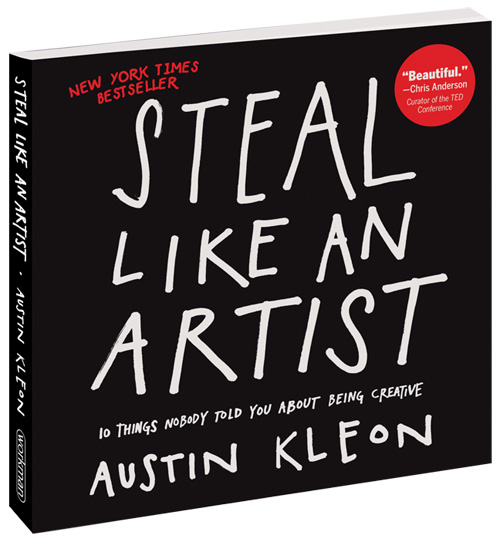
Steal Like an Artist

I don't often make a sweeping blanket statement (or did I just make one?) but today I will. Every creative person, be they author, singer, songwriter, artist, performer, or simply a stay-at-home mother with a handful of fresh veggies in a kitchen and a wish for an exotic meal should read this book:


I had never heard of it until two days ago. I had never known about it till 12:30 or 1:00 this morning when I was hanging with my older brother in the kitchen and reading the introduction. Daniel had been listening to a podcast by one of his favorite bands and the lead singer raised this book to the camera and said, "Read it."

Daniel, standing in our kitchen in the dead of night while I scavenged around the leftover yellow cake with chocolate icing, said something similar. "You should read it. I'm here till tomorrow afternoon." And you know what? There's something imminent and approachable about a book like this that makes you want to obey that ubiquitous command. Daniel didn't buy Steal Like an Artist because Mike Donahey said to, but because he knew he needed it. In the same way, I didn't go to bed at 1 a.m. and wake up at 7:30 when I could have slept in because Daniel told me to, but because I knew I wanted and needed to read this book.

I finished it in an hour.

It became a favorite in ten minutes.

And so I'm telling you, you need to read it. The thing that impressed me most about Austin Kleon's book was not the fact that it is for creative people or even the fact that it is full of cool little diagrams and witty humor. What endeared this book to me from the first chapter is the way he takes the small things in life seriously. Decisions are important. Little things upon little things do make up the big things.
"Just as your familial genealogy, you have a genealogy of ideas. You don't get to pick your family, but you can pick your teachers and you can pick your friends and you can pick the music you listen to and you can pick the books you read and the you can pick the movies you see. You are, in fact, a mashup of what you choose to let into your life."
-Austin Kleon Steal Like an Artist
This book is like common sense bottled into a volume the size of a c.d. Time and time again I'd read a phrase and smile. It's not that Kleon has come up with anything out of the ordinary. But he has created one of those books that takes the grand realm of my vague thoughts and impressions and gives form to it. That's what we creatives are here for, you know: to gather the floaty bits and give 'em shape. Everyone has floaty bits. It's only the real artists who can collect and tame them for presentation to another person.

Kleon busts myths like "Write what you know", corrects wrong opinions like "imitation is flattery", and leaves you at the last page feeling like a combination of superhuman, Kinfolk magazine, and fair-trade coffee. And then, with a smirk you can hear across the miles and through the pages, he recommends not paying four bucks for a latte when you could be saving money. Like, "Oh, not only have I written a manifesto of creativity, but your coffee houses where you feel so validated as an artist are totally stealing your pocket money. Starving artist--ever heard of it? Yeah. Starbucks started the trend."

Okay, so maybe he wasn't that blunt, but I loved it. In this little powerhouse of paper, Austin Kleon addresses the need for a day job, the value of living a really, well, boring life so you can actually get work done, and the necessity of stepping away from the computer and working analog:
"Just watch someone at their computer. They're so still, so immobile. You don't need a scientific study (of which there are a few) to tell you that sitting in front of a computer all day is killing you, killing your work ...You need to find a way to bring your body into your work. Our nerves aren't a one-way street--our bodies can tell our brains as much as our bodies. You know that phrase, 'going through the motions;? That's what's so great about creative works: If we just start going through the motions, if we strum a guitar, or shuffle sticky notes around a conference table, or start kneading clay, the motion kickstarts our brains into thinking."
-Austin Kleon Steal Like an Artist

I'm going to say it once more: "Read it." Let's see how long you can resist.


Tuesday, April 15, 2014

Mob Ink: an experiment in humor

It isn't easy living by your pen. Writer Fizz Sheridan knows this better than most--he hasn't eaten meat for a week and a half and his last shave was three days ago. But when his novel inspired by a mob crime he witnessed hits Chicago's bookshelves, Fizz finds the real mob overly interested in his life. Kidnapped and taken to headquarters, living by his pen gains new definition when Fizz is told that mob boss Eddie Harold Howard will only let him live if he continues the story of the mob every night. Love tangles, heists gone wrong, and a covey of other problems beset the gang, and the unfortunate Fizz is left with the smoking gun...pen; every incident belonged to the story Fizz told the night before, and Eddie Harold Howard is sure his captive has an ink-vendetta.
The majority of you seemed to like the idea of Mob Ink, so I scrawled up another bit of it the other night just to find my way into the setting and characters a bit more. At the moment, I'm just toying around with bits and smidgens of things when I have the chance. I'm much too busy to buckle down to anything till I've finished editing my mystery, but this rule doesn't go to hand-scrawled things, does it? So I sat on the porch in the middle of my own beetle-flood (so terrifying) and wrote this. Enjoy.


When he stopped to listen, the tick of little beetle toes against little beetle wings filled the space between them. Fizz shifted just a fraction against the wall. Now a forgotten nail threatened to pierce his spinal cord and let his fluid, but at least his head was a bit out of prime bug-drop territory. The ticking-clickery grew louder as if the small beetle cousins were being sent to bed by those of a larger variety whose fancy ran toward having a jazzy dance on the features of the rich and famous. Party-beetles; freakish idea.
A cat—an exceedingly Dust-Bowl specimen of the breed—poked his head into the alleyway from behind an ashcan and chewed on a fish bone, reflective. He blinked at Fizz and his captor then withdrew, disinterested. He was not a very sympathetic animal; obviously entirely unable to appreciate the terror of having one’s head bludgeoned by bombardier insects.
Fizz’s captor, the one with eyes like light-sockets—not the one with the camel-forehead—lounged with him against the wall. He did not seem concerned by beetles or bloodshed. Fizz, deep in some half-frightened, wholly interested part of his mind, speculated how he might be able to put that into a novel.
“Scared of neither beetle nor bloodshed,” he murmured.
“What?” Light Socket barked.
At his silent companion suddenly speaking, Fizz jumped right into the path of a droning,whizzing beetle. He quickly shifted to the other side, directly into Light Socket’s shoulder.
“What?” the guy demanded.
“We are…there are…too many beetles,” he ended lamely.
“So?” Socket lit his third cigarette of the hour and gnawed Fizz’s soul with his eyes.
Thoroughly disturbed, Fizz thought now would be prime opportunity to inquire his fate. He braved the bomber-squadron stream of beetle-y things and stood tall. His unfortunate head brushed the base of the light in its rust-encrusted fixture by the doorway. The glad beetle society embraced his eyes and nose and mouth and ears. Somewhere through the crush, Fizz saw Socket turn just the tiniest bit in his direction as if interested to watch the insect hoards.
“Why can’t we go in?” Fizz meant to say, but with all the joyous bug population using his lips like the Blarney Stone, what came out was more of: “Vy kunt ve do din?”
“Speak English,” Socket ground out over the cigarette.
Fizz puffed a colony of adoring insects from his face and thrashed wildly with his palms as if to stay the ticklish flood. “Whycan’twegoin?” he crammed out before the mass descended again.
Slowly, gracefully, a luna moth parted the way between Fizz and the beetles and settled on the light fixture. Grateful to the moth for at least not clicking like a miniscule pair of Chinaman’s chopsticks, Fizz smiled. He’d forgotten—it all seemed so distant now—but today was the first day of April and just that a.m. he’d been heading down to Lake Michigan with a yellow tulip in his buttonhole. Somewhere between the mugging and this alleyway, the tulip had been lost, but the reflection imbued Fizz with an iota of hopefulness. This was April First after all. Perhaps this whole business was nothing but a huge joke played on him by his eternally inappropriate roommate; it wouldn’t be the first time Marvin had done something idiotic for a laugh.
“We can’t go in cuz the boss hasn’t comed out.” Socket’s explanation was terse and wasted no bonhomie.
“We have to wait for his okay? While the—” Fizz phiffed a miniscule insect off his upper lip and refocused: “While the beetles gobble our face off?”
“Smoke.” Socket offered Fizz his half-burned cigarette.
“Much obliged.” He saluted his kidnapper with the butt end then put it in his mouth and drew in a draught of tobacco smoke.
The flavor turned his stomach, but it wasn’t half bad compared to sticking out the Beetle of Armegeddon. White smoke followed his exhale. Fizz was pleased to see a distinct reduction in the amount of beetles in his immediate vicinity. Maybe this guy wasn’t so awful. He’d given him a way out of suffering…maybe Socket wouldn’t kill him after all. At least, Fizz reflected with the second draw, at least he’d not die at the hands of beetles.

Monday, April 14, 2014

Guess What the Cat Just Let Outta the Bag?

Last Friday, I got my first paycheck. Could it be that I am finally moving out of perpetual Micawberism to something a bit more...pocket-moneyish? Seems like. The first week of nannying went quite well and my two wards and I even wrote and illustrated bed-time books for them. That was, after all, Lila's (5) first condition upon hearing I was an author: "Can Miss Rachel help me write a book? She can write the words and I'll draw the pictures." And so we did. This masterpiece is entitled: The Princess And Her Dragon and is about a royal who is afraid of the dark and the brave and "huge-big" dragon named William who is given to her as a gift to puff fire all night so she won't be without light. Lila dictated to me and most of the words were her own. (Including the rather pithy line: "And she was no longer afraid because she had the moon and the stars and fire and she knew that light was on her side.") In case you were wondering, for Lila, this was rather autobiographical. All except the dragon part. She specifically asked to write a book to read before bed so she would not be afraid.

I am excited for two reasons:

#1: I ought to be getting Elisabeth Grace Foley's Mrs. Meade Mysteries Vol. I today and I am looking forward to being able to read these stories in paperback edition. I am in the middle of three books right now so I can't start straight away, but I shall soon!

#2: Anne Elisabeth emailed me this morning and we have an official release date for Five Glass Slippers! Not certain whether it was meant to be public but I tweeted and spilled the proverbial beans before giving it much thought so, you will all be able to purchase this amazing collection of stories on

June 14th, 2014


And you know what's even cooler about this news? You can officially pre-order Five Glass Slippers on Amazon.com! Also, go add it on Goodreads too! I know it's an amazing book because I let myself read the first chapter or two of each story and not only are the stories rather wonderful, but the book itself is precious in terms of interior design. You'll simply have to wait to find out what's what because I obviously cannot show you the galley-proof I also received in my inbox. If I've been a bit in regards to my own writing, it is only because I'm still editing Anon, Sir, Anon and it's going slowly because of work and on top of this, I'm about to start formatting a friend's debut novel and I'm in the depths of reading a certain amazing epic that, for all its virtues, must be read on the computer and is undoubtedly long (Wonderfully long, but length means time). So all that means that even if I knew what my next project was going to be, I have no time for it yet. So there. If you are interested to learn more about the various Cinderellas in Five Glass Slippers, you must head over to the blog dedicated to just such things and check it out! I cannot wait for June to come around so you can all read The Windy Side of Care...truly, I have a feeling you're going to like Alis... And now for some entirely random items on the list of things that you didn't need to know but will probably be interesting all the same:

Hand massages feel divine
Someone actually made the scones from my last post 
 If I was a character from LotR, I would be Sam, evidently
Agents of SHIELD's latest episode just about killed me
I am apparently a good public speaker
I am fonder than ever of Wodehouse
Our team is officially over 100% funded for our trip to Romania!